Relational advocacy that respects capacity, dignity and autonomy across complex life transitions

Service Overview

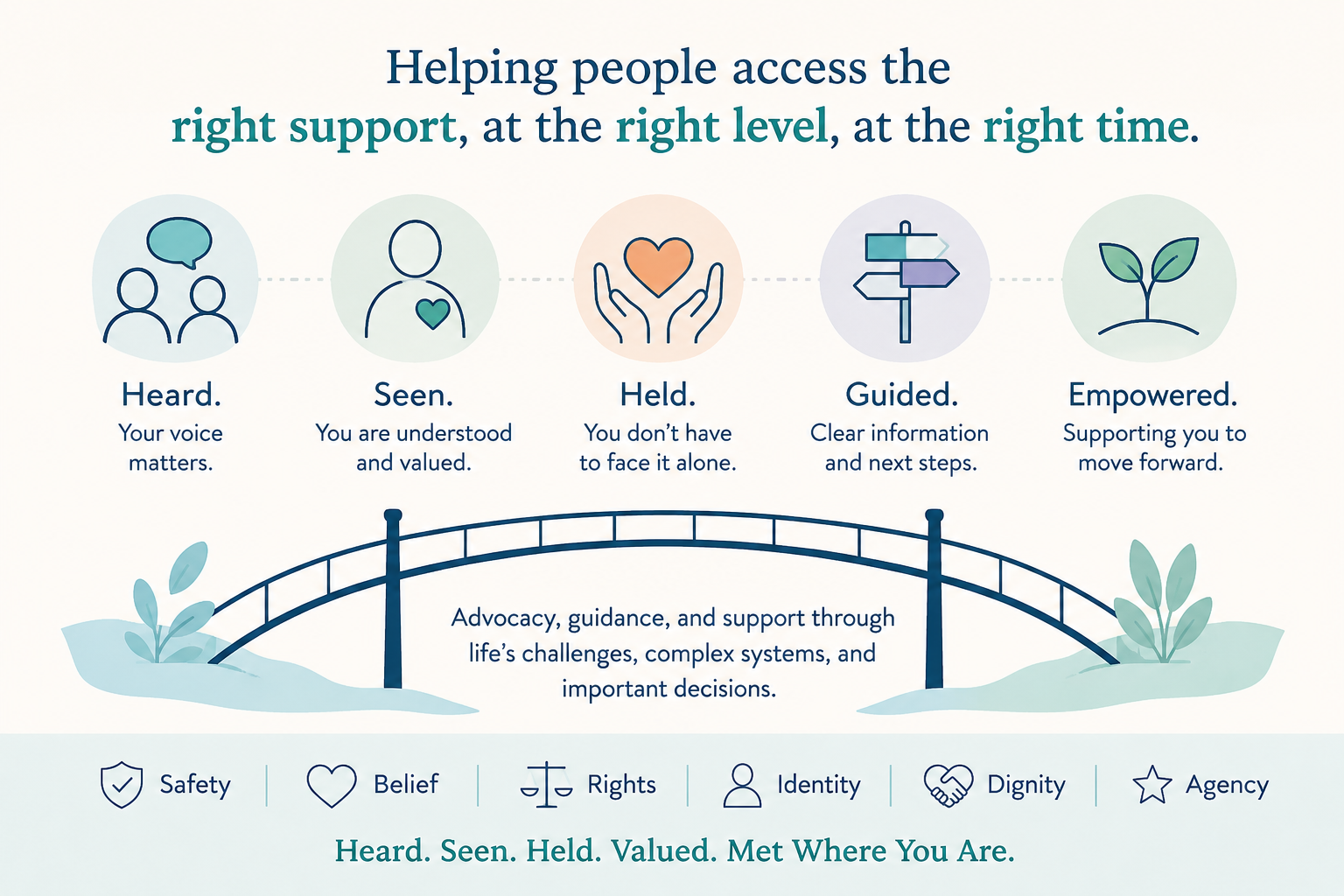
Advocacy Bridge CIC is a not-for-profit, community-focused organisation providing consent-led, one-to-one advocacy for adults who find it difficult to navigate services and systems independently.

Advocacy Bridge supports adults who don’t need rescuing — but benefit from having steady, relational support alongside them as they work out what’s next and regain confidence navigating systems in their own way.

We support people who are overwhelmed, disengaging, or quietly slipping through gaps, and we work alongside existing services to help support land in a meaningful and sustainable way.

Our role is practical and relational:

To support adults to engage effectively with statutory systems by ensuring their lived experience is clearly understood, accurately communicated, and sustainably represented.

To help them make sense of what’s happening, understand their options, and re-engage with services at a pace that supports safety, dignity, and autonomy.

We often support adults affected by trauma, late-identified neurodivergence, burnout, or periods of instability — particularly where traditional processes feel inaccessible or overwhelming.

As a Community Interest Company, all activity is for public benefit. Any surplus is reinvested into clearer pathways, practical tools, and accessible guidance that reduce drop-out and exclusion.

Why Our Approach Works

Many adults struggle to engage with services at the very point they need support most — not because help isn’t available, but because it isn’t accessible when someone is overwhelmed, distressed, or cognitively fatigued.

Systems are often complex, fast-paced, and reliant on real-time communication. They assume clarity, executive functioning, and emotional regulation — even when someone is under sustained strain.

When capacity drops, engagement becomes fragile.

Appointments are missed.
Forms remain unfinished.
Deadlines pass.
Communication breaks down.

Not due to lack of motivation — but because there is a mismatch between system demands and human capacity.

Without recognition of that mismatch, support can quietly stall or collapse.

Advocacy Bridge exists to bridge this gap.


Our Approach

Our work is relational, structured, and consent-led.

We provide continuity during periods of instability, helping individuals regain orientation and stay safely engaged with the services around them.

When someone cannot progress independently, we:

  • Clarify priorities and realistic next steps

  • Break complex information into manageable pieces

  • Translate system language into clear, accessible explanations

  • Offer calm, consistent guidance during overload

  • Support communication and self-advocacy before, during, and after key conversations

We do not replace statutory or clinical services.
We strengthen engagement with them.


What This Makes Possible

By working at the pace of a person’s capacity, we reduce disengagement and increase the likelihood of sustainable progress.

Our aim is simple:

To prevent people from slipping through gaps and to support safer, more consistent engagement with the systems designed to help them.

🌿 How Support Works

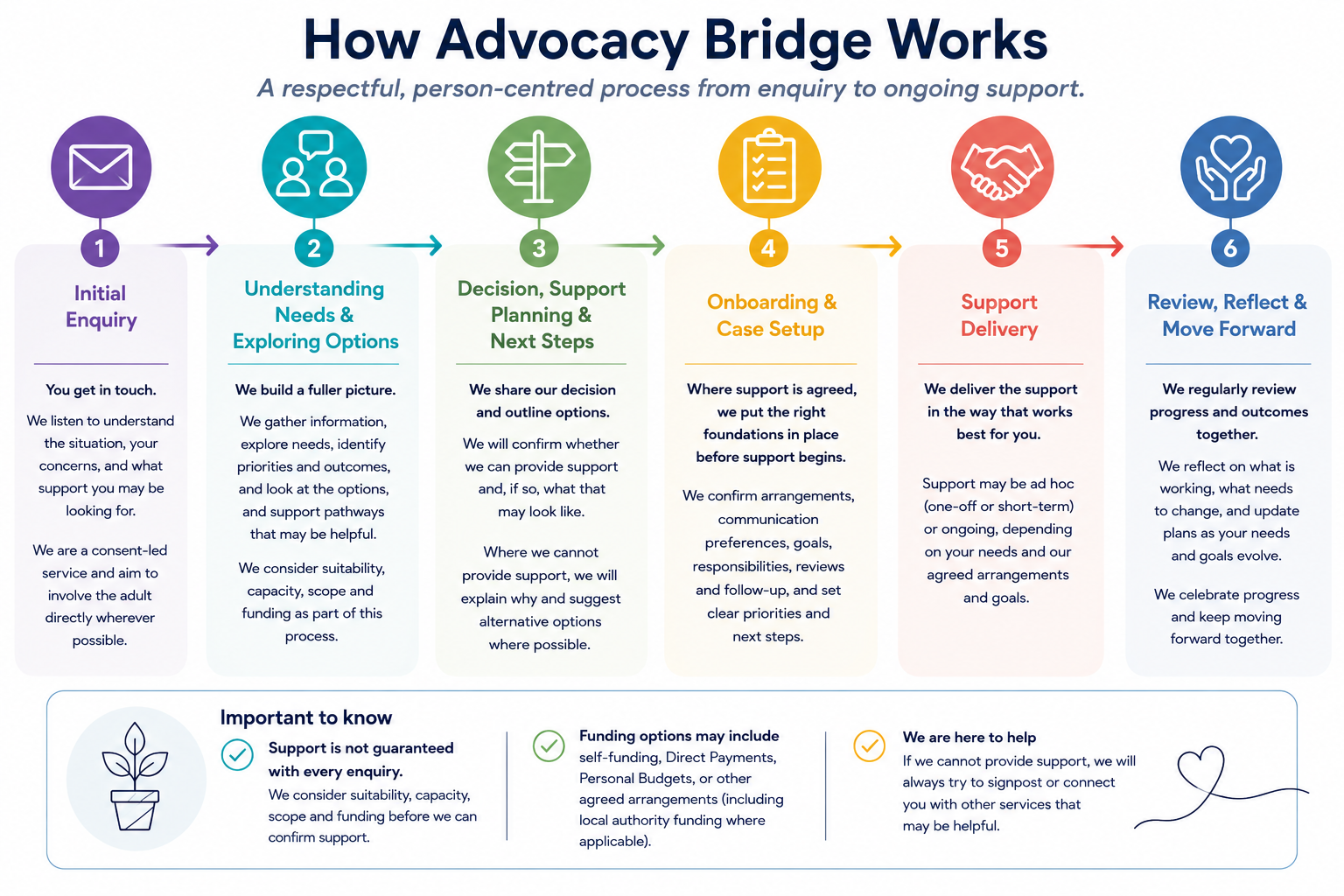
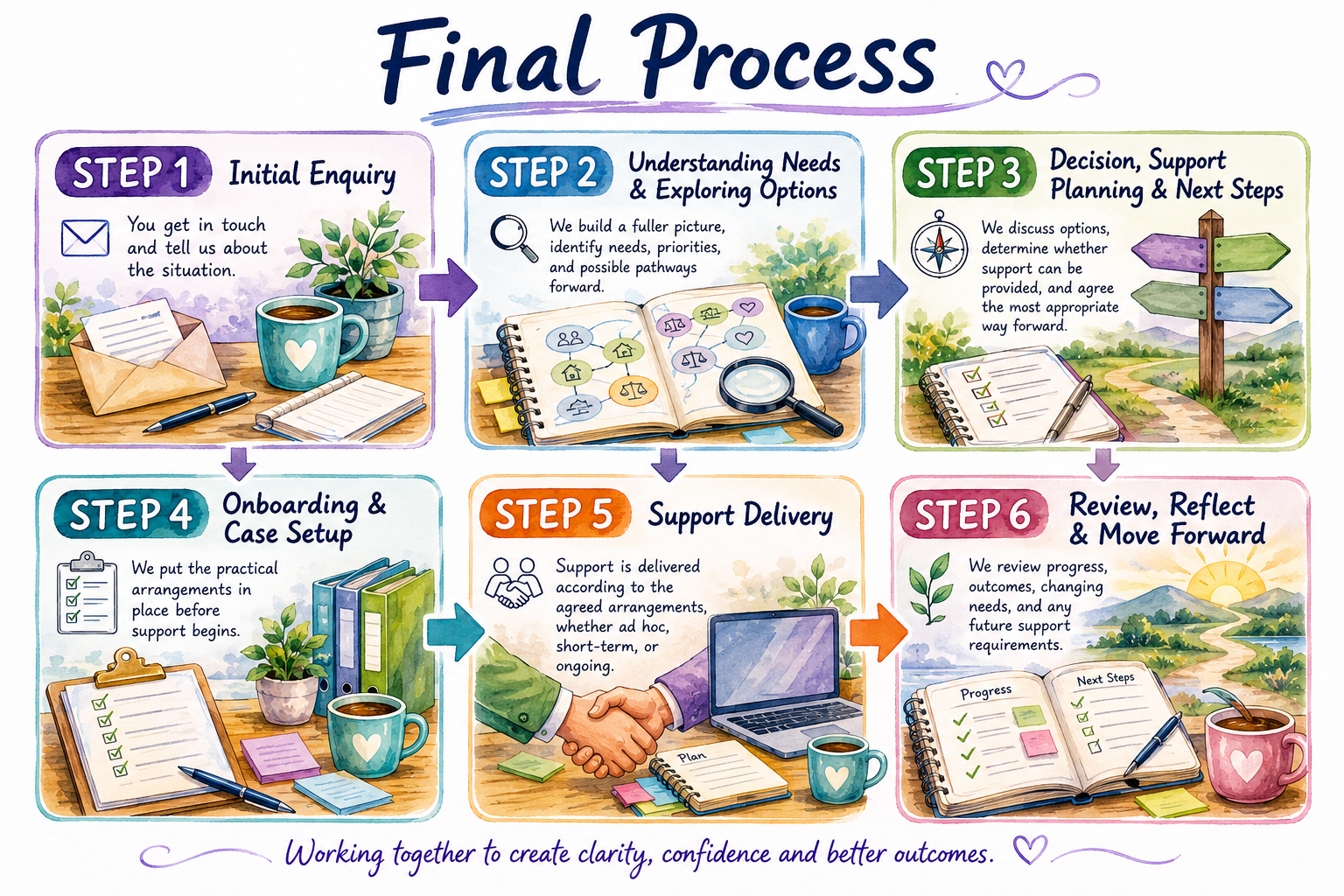
Advocacy Bridge offers structured advocacy and navigation support to help people move forward with clarity, confidence, and appropriate support.

Support is provided within agreed scope, capacity, and working hours. This helps ensure support remains steady and sustainable for everyone.

Support hours
Weekdays, 10am–4pm
Messages are responded to within capacity.

What Advocacy Bridge does not provide
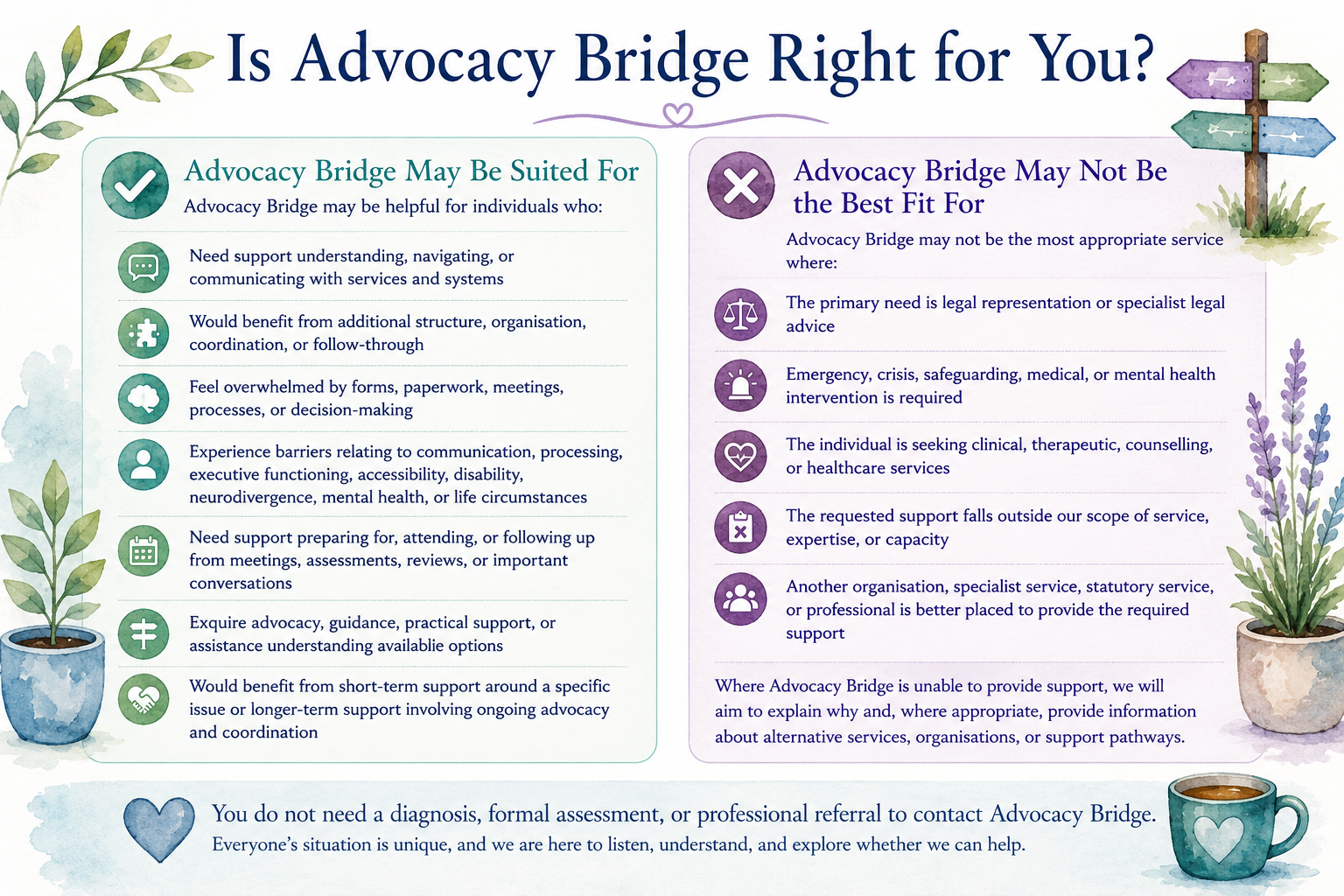
Advocacy Bridge is not a crisis or emergency service and does not provide legal or clinical advice. However we can help to identify and coordinate the right professionals and advocacy support so vulnerable adults are protected.

If you or the person you are supporting is in immediate distress or requires urgent help, please contact your GP, NHS 111, your local crisis team, or appropriate statutory services.

Need to Self-Refer?

You don’t need a professional referral — you can contact us directly.
You’re welcome to self-refer using the button below. The form is designed to be simple and low-pressure — you only need to share what feels comfortable. From there, we’ll explore support options together at a pace that feels manageable.

Bridging The Gap.

Who We Support

Referrers typically contact us when an adult:

• Is avoiding or disengaging from calls, emails, or appointments
• Feels too overwhelmed to complete forms, applications, or required processes
• Withdraws, shuts down, or masks distress during service interactions
• Struggles to articulate needs, priorities, or questions in appointments
• Is neurodivergent and experiencing executive functioning, decision-making, or processing difficulties
• Moves between services without clear progress or continuity
• Is distressed or at risk of disengagement but does not meet crisis thresholds
• Would benefit from calm, consistent relational support to remain engaged


We support adults who need additional help accessing and navigating services, particularly following trauma, late-identified neurodivergence, burnout, or periods of instability.

We often work in the space between statutory advocacy, therapy or coaching, and real-life administrative overwhelm — where practical support and relational continuity are needed.

Many people we support find it difficult to organise thoughts, communicate clearly under pressure, or follow through with complex tasks and decisions.

Referrals are commonly made when systems feel too complex to navigate alone and steady support would reduce the risk of disengagement.


What Referrers Can Expect

Collaborative working

We work alongside referrers and existing services, respecting roles and avoiding duplication.

Person-centred, consent-led advocacy

We support individuals until they feel able to understand options, communicate needs, and advocate for themselves.

Steady, regulating support

We provide calm, consistent support that stabilises engagement during overwhelm or transition.

Time-limited, purpose-led involvement

Our involvement remains focused and steps back once the person feels confident to continue.

Barrier-aware, non-judgemental approach

We identify and reduce practical, emotional, and communication barriers without blame or pressure.

Feedback into systems (with consent)

Where appropriate and agreed, we share insights that support more inclusive and workable pathways.


Our role is to support progress without pressure — creating conditions where people can engage safely, steadily, and sustainably.

How We Complement Existing Services

We work alongside existing services, helping people engage, follow through, and feel supported throughout their journey.

Our involvement can help reduce:

• Missed appointments
• Crisis escalation
• Repeat or stalled referrals

We are not a crisis service.
Instead, we provide the relational continuity and steady support that many systems don’t have capacity to offer.

We support individuals who may feel too overwhelmed, unwell, or unsure to take the first steps alone — staying alongside them until there is greater clarity, regulation, and confidence to move forward more independently.

How to Refer Someone

We welcome referrals from professionals, services, and community organisations.

Advocacy Bridge provides direct, one-to-one advocacy support for adults who may be struggling to engage with systems independently.


1. Confirm Consent

Please ensure the individual:

  • Understands what Advocacy Bridge offers

  • Is happy to be referred

  • Consents to their basic details being shared

We do not proceed without informed consent unless there is a safeguarding concern requiring statutory involvement.


2. Submit a Referral

With consent, please provide:

  • Name

  • Preferred contact details

  • Brief context (only what has been agreed to share)

Referrals can be submitted via our referral form or by email.


3. Direct Engagement

Once a referral is received, we work directly with the individual.

We aim to make initial contact within 24–48 working hours.

Where appropriate — and only with the individual’s informed consent — it may be helpful to seek brief input from one or two trusted supporters who are closely involved. This can help us build a balanced understanding of day-to-day reality and existing support.

Advocacy Bridge is not a case-holding or reporting service. We do not routinely provide updates or share information unless the individual has explicitly requested shared communication or consented to it.


4. Consent-Led Information Sharing

Information is only shared with other services where clear, informed consent has been given.

Our role is to provide steady, person-centred advocacy that helps individuals:

  • Understand their options

  • Strengthen communication

  • Re-engage with services

  • Move forward at a pace that supports safety and autonomy

🧭 How Advocacy Bridge Came to Exist

Advocacy Bridge CIC was created from lived experience, not theory.

Across communities, many people find themselves lost in a maze of services, forms, assessments, and waiting lists. Even when support exists, it can be hard to access, sustain, or navigate — particularly where services are stretched, pathways are unclear, or a person’s real capacity and needs aren’t easily recognised or communicated.

Support that should help can feel confusing or inconsistent, especially for those who have managed independently for years, until a change in health, capacity, or life circumstances makes things harder to navigate alone.

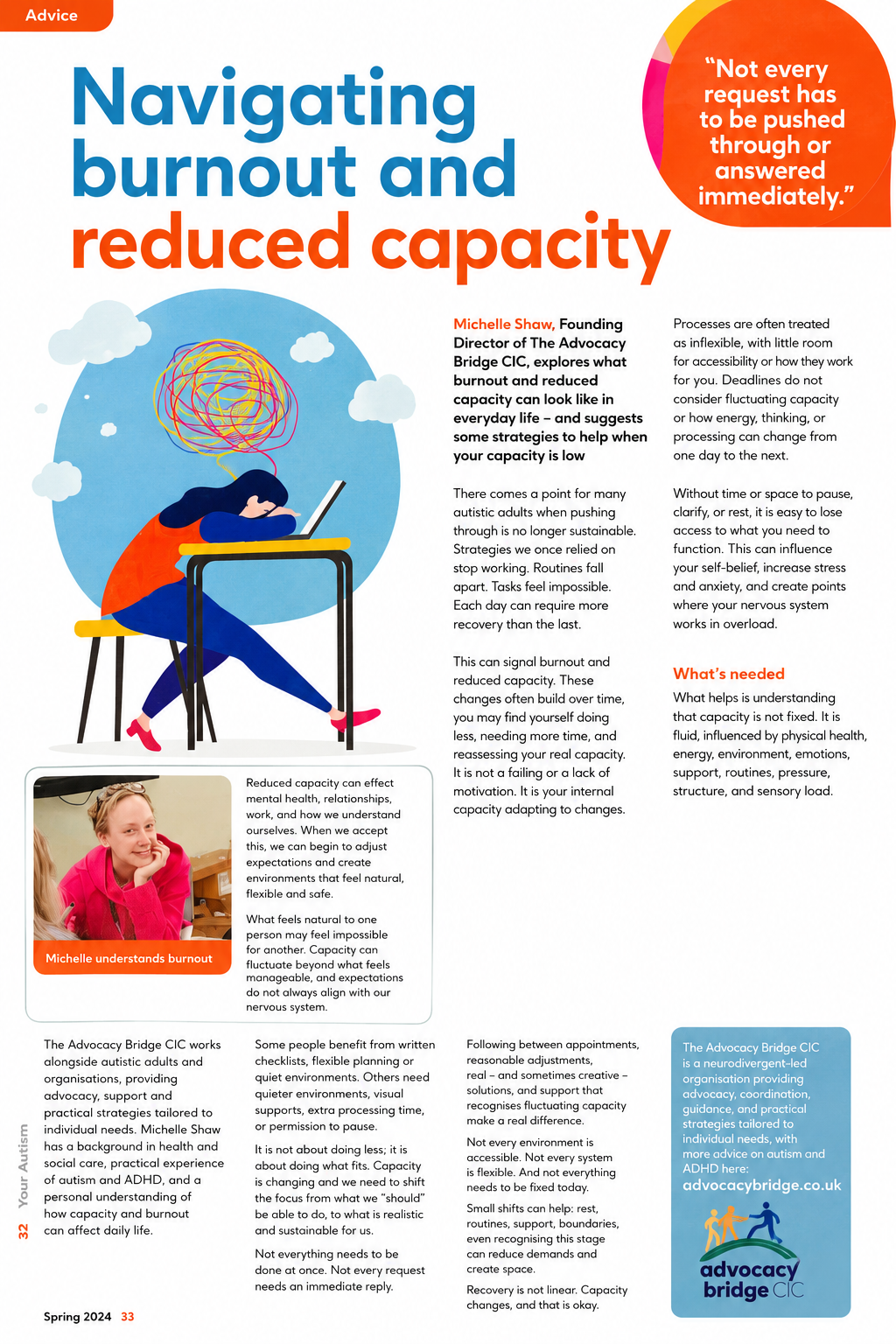
Through lived experience and community conversations — including those of our founder, Michelle Shaw — clear patterns began to emerge:

People unsure where to begin.
Unsure where to turn or who to trust.
Unsure of the systems, language, or unwritten rules.
Finding it hard to explain what they needed.
Unsure how to make themselves heard.

As these experiences were shared more openly, many people spoke about feeling stuck, overloaded, and overwhelmed by the different strands of their lives.

When support sat in separate “lanes,” some people found their situations were too complex for any one service to hold. Often shaped by survival and life circumstances, their needs didn’t fit neatly into one pathway — particularly where support was time-bound or session-limited.

When services ended or paused, continuity was often lost. Many people had to retell their story to each new professional, even when the questions were similar. For those with invisible disabilities, fluctuating capacity, or layered circumstances, their reality wasn’t always fully understood.

Many were capable in some areas while struggling significantly in others. When support didn’t meet them where they were, people could feel misunderstood or overlooked.

Over time, this left many feeling depleted, discouraged, and unsure where to turn next.

Advocacy Bridge CIC grew from recognising this gap.

It formalises an approach developed through lived experience and real-world support: now delivered in a structured, ethical, and sustainable way that benefits both the person seeking help and the professionals involved in their care.

We help people prioritise their physical and mental health and emotional wellbeing, slow things down, untangle complex situations, recognise barriers, build healthy boundaries, communicate clearly, and take steady steps forward when life feels stuck or overwhelming.

So people can regain clarity, confidence, and direction — with support that respects who they are, what they’re carrying, and space to move forward in ways that work for them.

“Michelle brings clarity, compassion, and gentle accountability — both for the people she supports and the professionals working around them.
She asks thoughtful questions and keeps the person at the centre of conversations and decisions

Health & Social Care Professional

“Our staff learned a great deal simply by observing how she works.
She holds space calmly, builds trust quickly, and helps conversations stay constructive and focused on what matters.”

Service Professional

“Michelle acts as a bridge between intention and delivery.
Where services can sometimes miss the mark, she helps ensure no one gets left behind.

Community Support Worker

“Michelle has a way of meeting people where they are without judgement.

She helps individuals feel safe enough to engage again, which makes a real difference to how they show up in our services.”

Community Organisation Lead

“Advocacy Bridge fills a gap we often see but don’t always have capacity to address.
Her support helps people stay engaged rather than dropping out when things feel overwhelming.”

Charity Coordinator

“Michelle brings a steady, grounding presence.
People relax when she’s involved because they know they won’t be pushed or judged.”

Group Facilitator

News & Updates

Traumasking: When Survival Becomes a Personality

Traumasking: When Survival Becomes a Personality

The structural relationship between trauma, masking, and identity continuity. There is masking. And then there is traumasking. Masking is often described as adjusting yourself to fit the environment—smoothing the edges, choosing the socially acceptable response,...

Most People Look at a Tombstone and See Dates

Most People Look at a Tombstone and See Dates

🌿 Most People Look at a Tombstone and See Dates. I Look at a Tombstone and See a Story. Not when someone lived —but how they lived.Who they became.What they fought for.What they survived.And how their soul evolved across the chapters of their one and only life. Maybe...

Get in Touch. Get Involved.

The Advocacy Bridge CIC is built on connection and collaboration. If you’d like to refer someone, partner with us, volunteer, or support our mission, we’d love to hear from you.

Matrix@Dinnington Business Centre, Nobel Way, Dinnington, Sheffield S25 3QB

📞 01709 262005

© Michelle Shaw 2024-2026 | Brand and Website Design by Wholeheartedly Laura