People shouldn't have to prove their worth, learn how to ask for help, navigate complex systems, or wait for services to catch up before they can access the support they need.

Why Advocacy Bridge Exists


Advocacy Bridge exists to build a community of people, organisations, professionals, funders, and lived-experience voices committed to ensuring vulnerable people are heard, seen, held, valued, and met where they are—with dignity, compassion, and respect.

Together, we work to remove barriers, amplify voices, protect rights, and create pathways to support, safety, and self-determination.

Too often, people are expected to prove their worth, learn how to ask for help, and navigate systems that were not designed with their needs in mind before they can access the support they need.

Advocacy Bridge exists to help bridge that gap.

We believe people shouldn’t have to face difficult situations alone, wait until they reach crisis point, or lose confidence in themselves before support becomes available.

Our aim is simple:

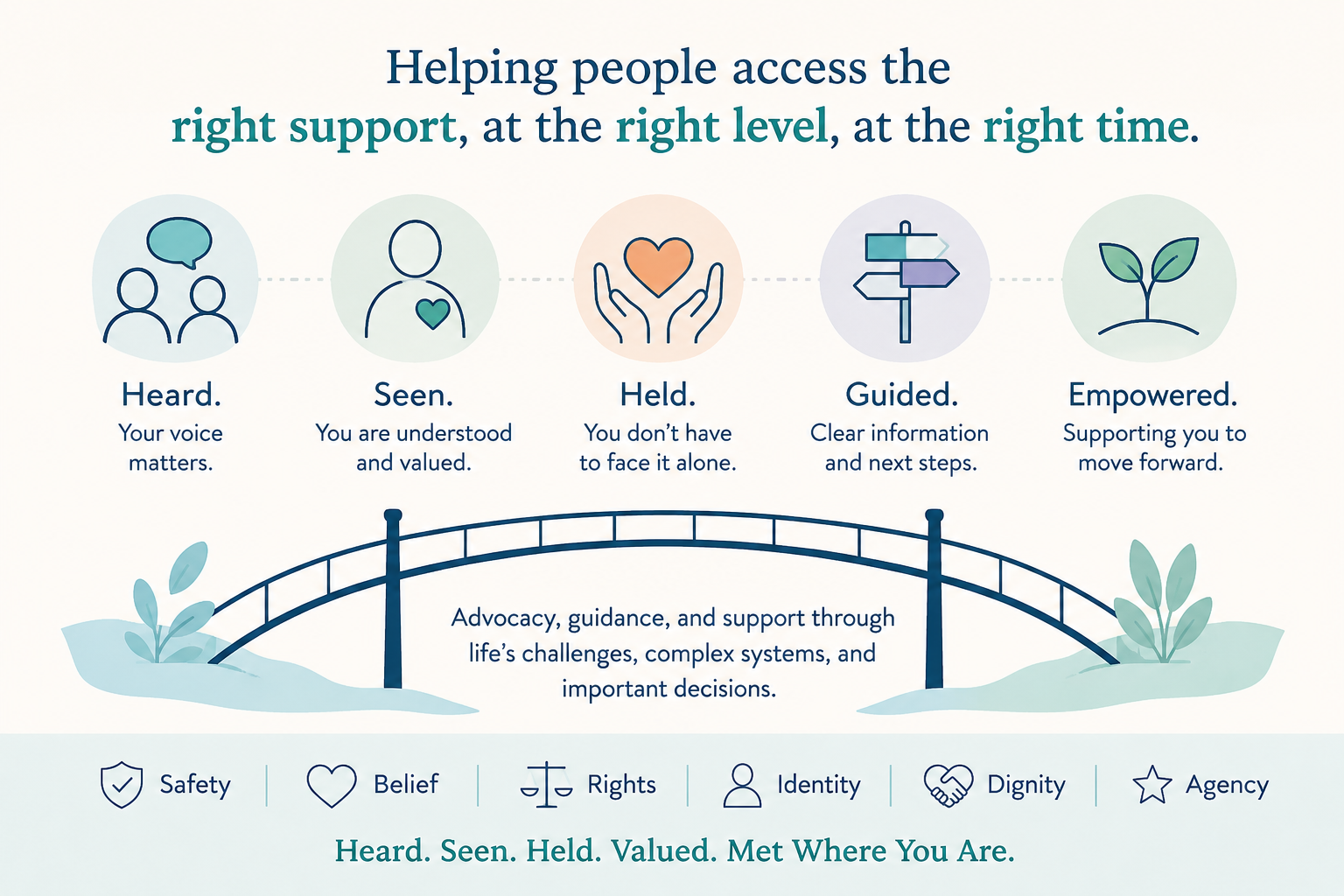
To help people access the right support, at the right level, at the right time.

By standing alongside people, strengthening communication, supporting informed decision-making, and helping people understand their options, we work to ensure individuals feel heard, seen, valued, and better able to move forward.

Our Approach

Advocacy Bridge provides structured, consent-led support that is collaborative, processing-aware, neurodivergent-informed, and focused on participation, communication, and accessibility.

We recognise that many systems rely on sustained organisation, communication, executive functioning, and processing capacity. During periods of stress, overwhelm, burnout, illness, disability, or increased life demands, these demands can become difficult to manage alone.

Our approach is informed by both professional experience and lived experience of neurodivergence and disability. We understand how overwhelming systems, decisions, communication, and day-to-day responsibilities can feel when things are unclear, unsupported, or moving too quickly.

Because of this, we work at a pace that is appropriate to the individual, providing structure, clarity, and practical support to help create calmer, more manageable pathways forward.

We aim to:

• Break complex situations into clear, manageable steps

• Present information in a structured and accessible way

• Repeat, clarify, or reframe information where helpful and without judgement

• Focus on realistic, achievable next steps that support progress without creating unnecessary overwhelm

• Use tools such as written notes, recordings, summaries, and structured follow-up to support continuity and understanding

• Help turn thoughts, concerns, and ideas into practical actions

• Support individuals to participate more effectively in decisions, conversations, and systems that affect their lives

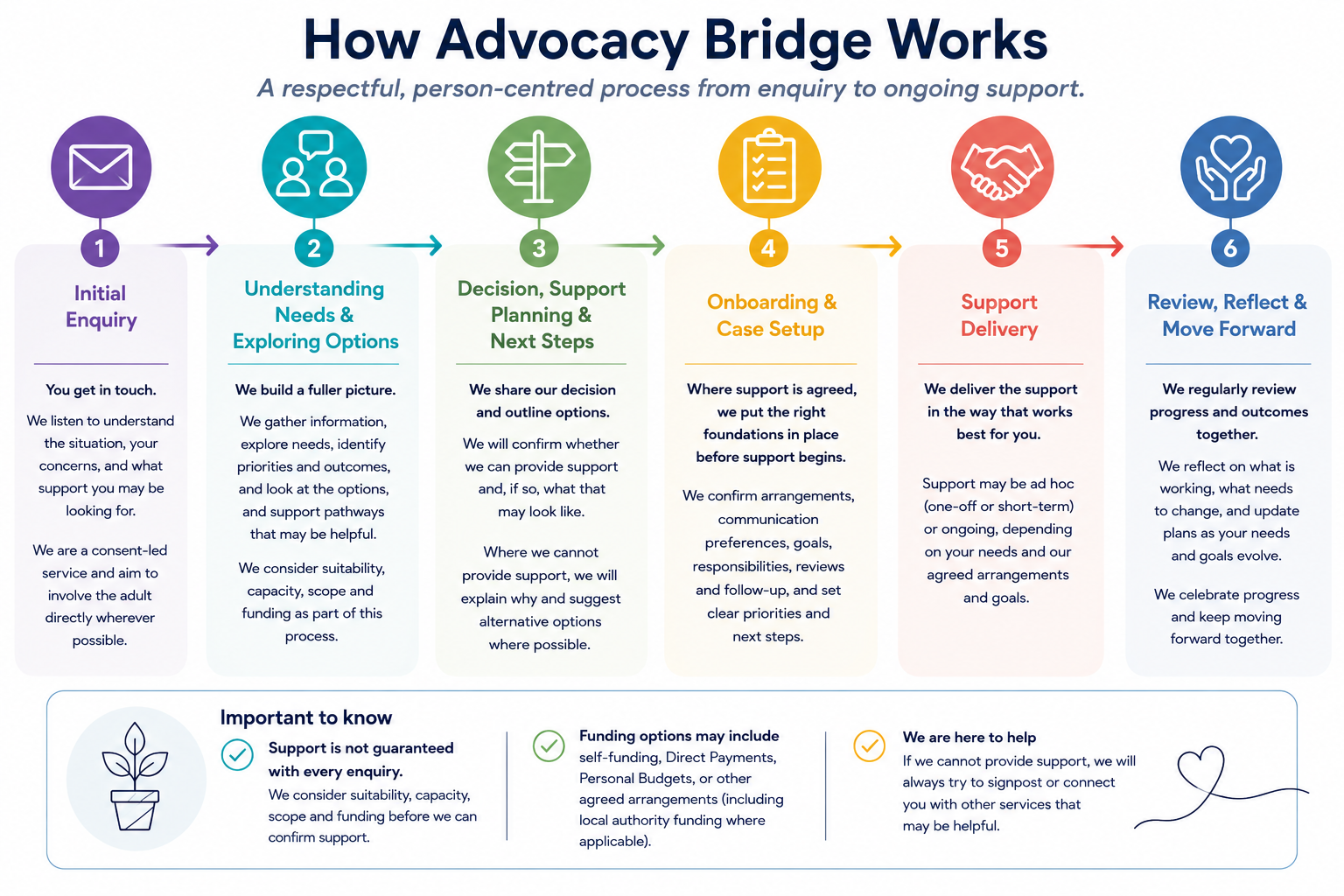
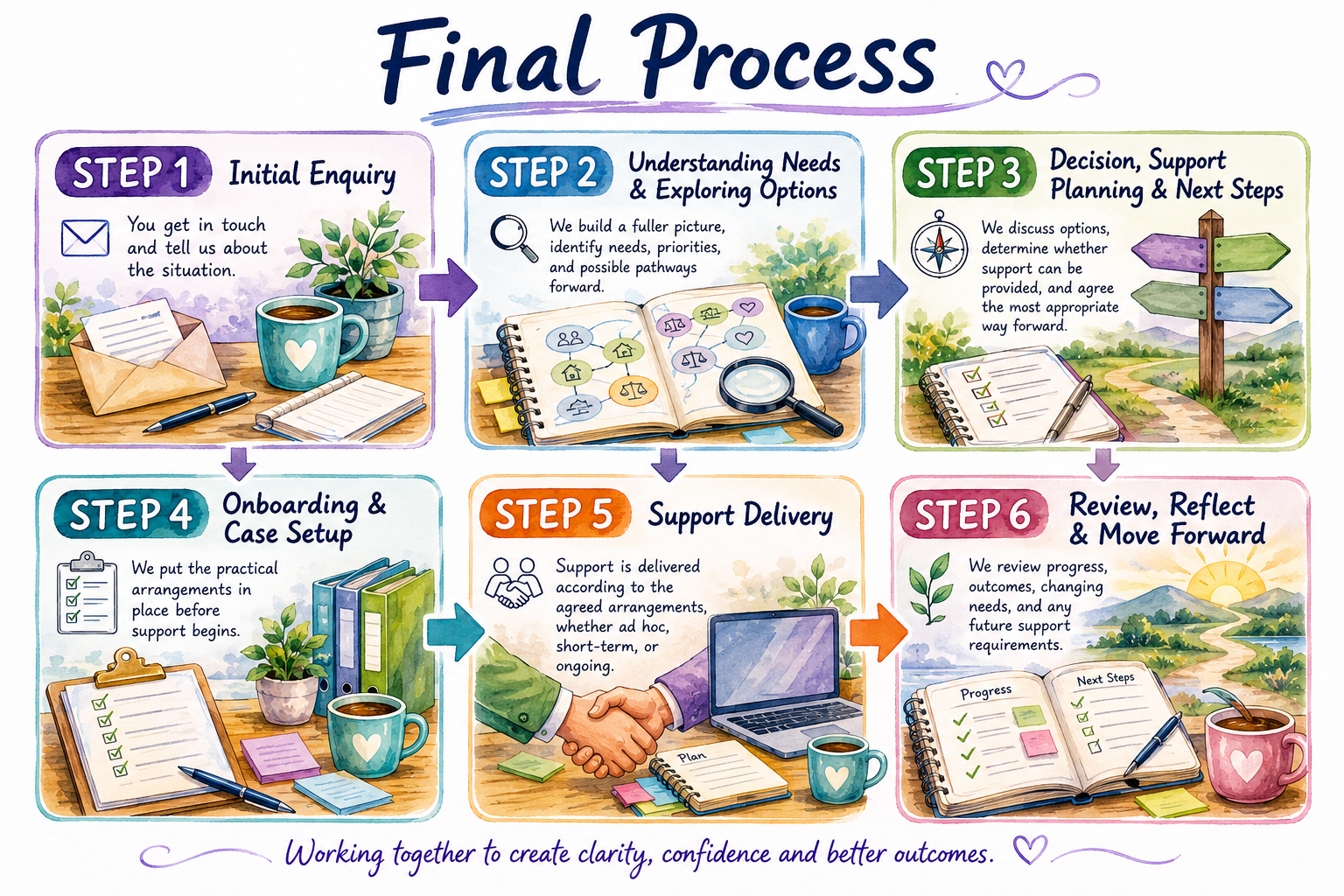
    Following the initial enquiry, we may work with the individual and, where appropriate, those involved in their support, to build a fuller understanding of the situation, identify priorities and needs, and explore possible options moving forward.

    Funding & Payment Options

    Support may be funded through private self-funding arrangements, Direct Payments, Personal Budgets, local authority commissioning, or other agreed funding arrangements where appropriate.

    Funding arrangements and eligibility requirements vary depending on individual circumstances and are discussed as part of the enquiry and assessment process.

    Please note that submitting an enquiry does not guarantee that Advocacy Bridge will be able to provide ongoing support.

    Before any support can be offered, we may need to consider factors such as the nature of the request, whether it falls within our scope of service, current availability and capacity, funding arrangements, and whether Advocacy Bridge is likely to be the most appropriate service for the individual’s needs.

    Where we are unable to offer ongoing support, we will aim to provide information, signposting, or alternative options where appropriate.

    The Advocacy Bridge Journey

    Is Advocacy Bridge Right for You?

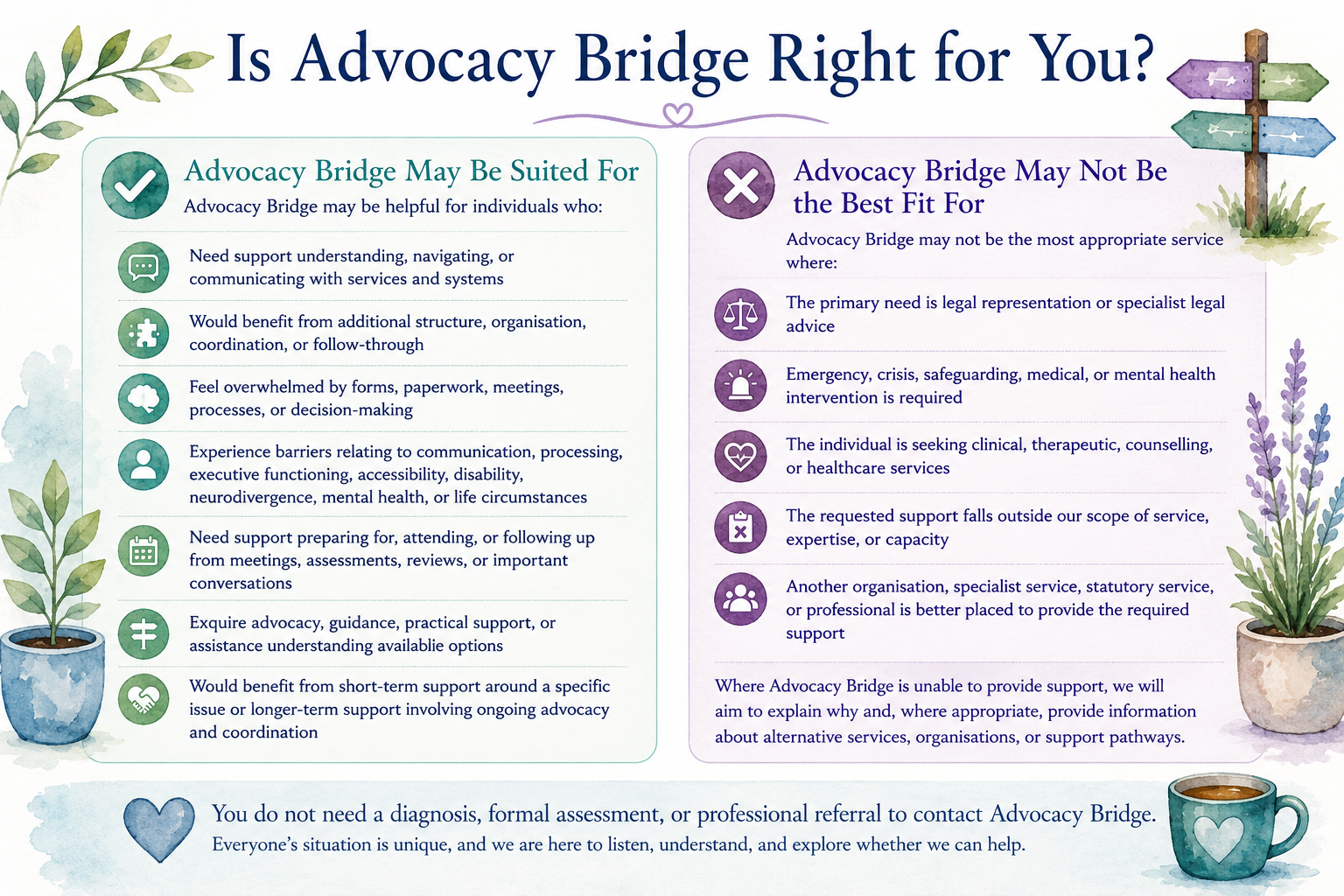
    Advocacy Bridge May Be Suited For

    Advocacy Bridge may be helpful for individuals who:

    • Need support understanding, navigating, or communicating with services and systems

    • Would benefit from additional structure, organisation, coordination, or follow-through

    • Feel overwhelmed by forms, paperwork, meetings, processes, or decision-making

    • Experience barriers relating to communication, processing, executive functioning, accessibility, disability, neurodivergence, mental health, or life circumstances

    • Need support preparing for, attending, or following up from meetings, assessments, reviews, or important conversations

    • Require advocacy, guidance, practical support, or assistance understanding available options

    • Would benefit from short-term support around a specific issue or longer-term support involving ongoing advocacy and coordination

    Advocacy Bridge May Not Be the Best Fit For

    Advocacy Bridge may not be the most appropriate service where:

    • The primary need is legal representation or specialist legal advice

    • Emergency, crisis, safeguarding, medical, or mental health intervention is required

    • The individual is seeking clinical, therapeutic, counselling, or healthcare services

    • The requested support falls outside our scope of service, expertise, or capacity

    • Another organisation, specialist service, statutory service, or professional is better placed to provide the required support

    Where Advocacy Bridge is unable to provide support, we will aim to explain why and, where appropriate, provide information about alternative services, organisations, or support pathways.

    What Happens After You Contact Us?

    Once we receive an enquiry or referral, we will review the information provided and make contact using the preferred communication method wherever possible.

    We may arrange a follow-up conversation to better understand the situation, current support in place, communication needs, and whether Advocacy Bridge is likely to be an appropriate fit.

    Some situations are straightforward, while others may require additional conversations, documents, or clarification before next steps can be identified.

    📨 We review your enquiry or referral.

    💬 We make contact using your preferred communication method.

    🔍 We gather any additional information needed.

    🧭 We explore possible options and next steps.

    🤝 Where appropriate, we discuss support arrangements.

    As Featured in Your Autism Magazine

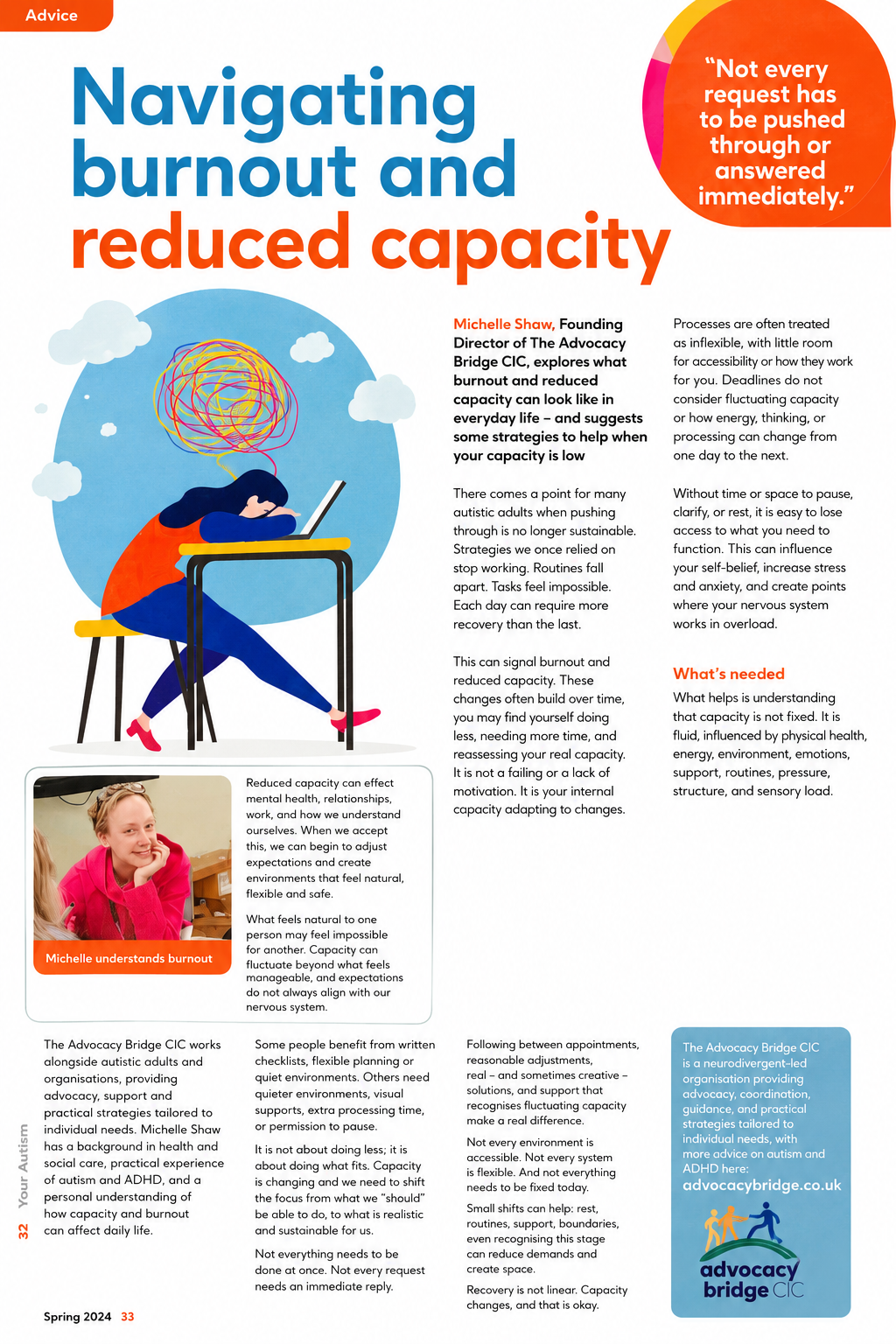
    Michelle Shaw, Founder of Advocacy Bridge, was featured in the Spring edition of Your Autism magazine with her article “Navigating Burnout and Reduced Capacity.”

    Drawing on both professional and lived experience, Michelle explores how burnout, fluctuating capacity, and overwhelm can affect autistic adults, alongside practical strategies for navigating periods of reduced capacity with greater understanding and self-compassion.

    Key Topics Discussed

    • Burnout and reduced capacity

    • Executive functioning and processing demands

    • Communication, accessibility, and support needs

    • Self-compassion and realistic expectations

    • Sustainable approaches to everyday life


    Why Advocacy Bridge Was Created

    The experiences discussed in this article reflect many of the challenges faced by the individuals who contact Advocacy Bridge.

    Our work is built around helping people navigate systems, communicate effectively, access support, and move forward in ways that are realistic, manageable, and tailored to their circumstances.

    Traumasking: When Survival Becomes a Personality

    The structural relationship between trauma, masking, and identity continuity.

    There is masking.
    And then there is traumasking.

    Masking is often described as adjusting yourself to fit the environment—smoothing the edges, choosing the socially acceptable response, performing the version of yourself that allows things to function.

    But traumasking is different.

    Traumasking is not about fitting in.
    It is about staying safe.

    It is what happens when your nervous system learns—over months, years, or decades—that being fully visible comes with consequences. Not always dramatic consequences. Often quiet ones. Withdrawal. Disapproval. Dismissal. Withdrawal of support. Emotional volatility. Loss of stability.

    So you adapt.

    Not consciously at first.
    But systematically.

    You learn to pause before reacting.
    You learn to monitor the room before speaking.
    You learn to override your own discomfort.
    You learn to prioritise stability over authenticity.

    Eventually, you stop noticing you are doing it.

    It becomes automatic.

    It becomes you.


    What Traumasking Describes

    Traumasking describes sustained nervous system–driven masking adopted to preserve safety, stability, or attachment, which becomes structurally integrated into identity, functioning, and relationships.

    It explains phenomena existing terms do not fully capture:

    • Appearing highly functional while internally overridden
    • Identity collapse after prolonged survival adaptation
    • Late recognition of authentic needs
    • Why people cannot simply “stop masking” without destabilising their life

    It bridges multiple domains:

    • Trauma psychology
    • Autism masking research
    • Nervous system regulation theory
    • Relational trauma
    • Systemic dependency and power dynamics

    The Difference Between Masking and Traumasking

    Masking can be situational. Traumasking is structural and deeply psychological.

    Masking might help you navigate a meeting, a social event, or a professional role.

    Traumasking shapes your baseline operating system.

    It is driven less by social preference and more by nervous system conditioning—a learned belief that your unfiltered responses could destabilise something essential: a relationship, your housing, your income, your belonging, or your safety.

    Traumasking often includes:

    • Appearing calm while internally overwhelmed
    • Agreeing when your body is signalling no
    • Downplaying your needs to avoid being perceived as difficult
    • Remaining functional while privately shutting down
    • Losing clarity about what you genuinely feel or want

    Not as a flaw, but as a necessary adaptation. A learned survival response.

    Your nervous system learned to prioritise safety over expression and became highly skilled at protecting continuity.


    When Survival Skills Outlive the Danger

    Traumasking is adaptive. It works.

    It allows you to maintain relationships.
    It allows you to continue working.
    It allows you to function within systems that do not adapt to you.

    It buys time.

    But survival adaptations are not designed to run indefinitely.

    Over time, traumasking can create a growing internal separation between:

    • what you feel
    • what you think
    • what you show
    • and what others believe is true about you

    From the outside, you appear capable. Reliable. Stable.

    From the inside, maintaining that presentation can require enormous energy.

    This is why many people who have traumasked for years appear “fine” until the moment they are not.

    The collapse is rarely sudden.

    It is cumulative.


    When Needs Were Never Safe to Exist

    One of the most disorienting aspects of traumasking is not the masking itself.

    It is what becomes visible when the mask can no longer be sustained.

    Needs that were always present begin to surface.

    Not new needs.
    Not weaknesses that suddenly appeared.

    Needs that existed all along—but the environment, and the relationships everything depended on, never made it safe for them to be expressed.

    When your housing, your income, your belonging, or your emotional safety is tied to stability, your nervous system learns quickly what must be contained.

    Not consciously.

    Biologically.

    Over time, you may lose access to your own internal signals and feelings—not because they disappeared, but because responding to them was never a safe option, and because autonomy had been eroded so gradually you forgot it was ever possible.


    Traumasking and Late Realisation

    For many late-diagnosed autistic and neurodivergent adults, traumasking complicates self-recognition.

    You may not realise you were masking, because it did not feel like performance.

    It felt like responsibility.
    It felt like maturity.
    It felt like being reasonable.

    You may have believed your role was to absorb pressure so others did not have to.

    Until your capacity changed.

    Until your nervous system refused to continue overriding itself.

    Until functioning, living, or working the way you always had was no longer possible.

    This is often misinterpreted by others as regression.

    In reality, it may be the first time your nervous system is no longer able—or willing—to maintain the traumask.


    The Identity Question

    When traumasking has been present for decades, it becomes intertwined with identity, relationships, and livelihood.

    Removing it is not simply a psychological shift.

    It is a structural one.

    It affects how you communicate.
    What you tolerate.
    What you can sustain.
    What you are willing to override.

    And often, it reveals the truth your nervous system has been carrying quietly for years—visible only once you know how to see it.


    The Nervous System Context

    Modern trauma science shows the nervous system prioritises:

    • safety
    • attachment
    • predictability

    If authenticity threatens those, the nervous system suppresses authenticity.

    Not consciously.

    Biologically.

    Traumasking is a logical extension of this survival mechanism.


    Traumasking Is Not a Personal Failure

    Traumasking is not dishonesty.
    It is not manipulation.
    It is not weakness.

    It is a nervous system adaptation developed in response to environments where authenticity carried risk.

    It reflects intelligence. Pattern recognition. Relational sensitivity. A drive to preserve continuity.

    The problem is not that traumasking exists.

    The problem is when systems, workplaces, and relationships become dependent on it—when your ability to override yourself becomes the invisible foundation everything else rests upon.


    Recognition Is the First Shift

    You do not remove traumasking overnight.

    And in many situations, some degree of masking remains necessary.

    But recognition changes the relationship.

    You begin to notice when you are overriding yourself.

    You begin to distinguish between genuine agreement and protective compliance.

    You begin to understand your own capacity in real time.

    For many people, naming traumasking is the first moment they realise:

    Their gut knew.
    Their heart adapted.
    Their mind is only now catching up.

    They were strong for longer than their nervous system was designed to be.

    Despite how many people have survived trauma, masking, and dissociation, structured guidance for safely reconnecting with yourself remains fragmented, inconsistent, and often absent.

    Many are left to find their way back alone.


    Traumasking (noun): the nervous system–driven suppression of authentic thoughts, needs, and reactions in order to maintain safety, stability, or belonging in environments shaped by relational or systemic threat.

    If you have ever thought:

    “I don’t recognise myself anymore.”
    “I don’t know what’s real.”
    “I thought that was just who I was.”

    Naming it is often the first step toward understanding what actually happened.

    I’m interested to hear whether this resonates with your experience—personally or professionally.
    You’re welcome to share your perspective and connect with me on linkedin or my substack to continue the conversation.

    #Traumasking #TraumaInformedCare #Neurodiversity #LateDiagnosis #BurnoutRecovery #NervousSystem #InvisibleDisability #Advocacy