People shouldn't have to prove their worth, learn how to ask for help, navigate complex systems, or wait for services to catch up before they can access the support they need.

Why Advocacy Bridge Exists


Advocacy Bridge exists to build a community of people, organisations, professionals, funders, and lived-experience voices committed to ensuring vulnerable people are heard, seen, held, valued, and met where they are—with dignity, compassion, and respect.

Together, we work to remove barriers, amplify voices, protect rights, and create pathways to support, safety, and self-determination.

Too often, people are expected to prove their worth, learn how to ask for help, and navigate systems that were not designed with their needs in mind before they can access the support they need.

Advocacy Bridge exists to help bridge that gap.

We believe people shouldn’t have to face difficult situations alone, wait until they reach crisis point, or lose confidence in themselves before support becomes available.

Our aim is simple:

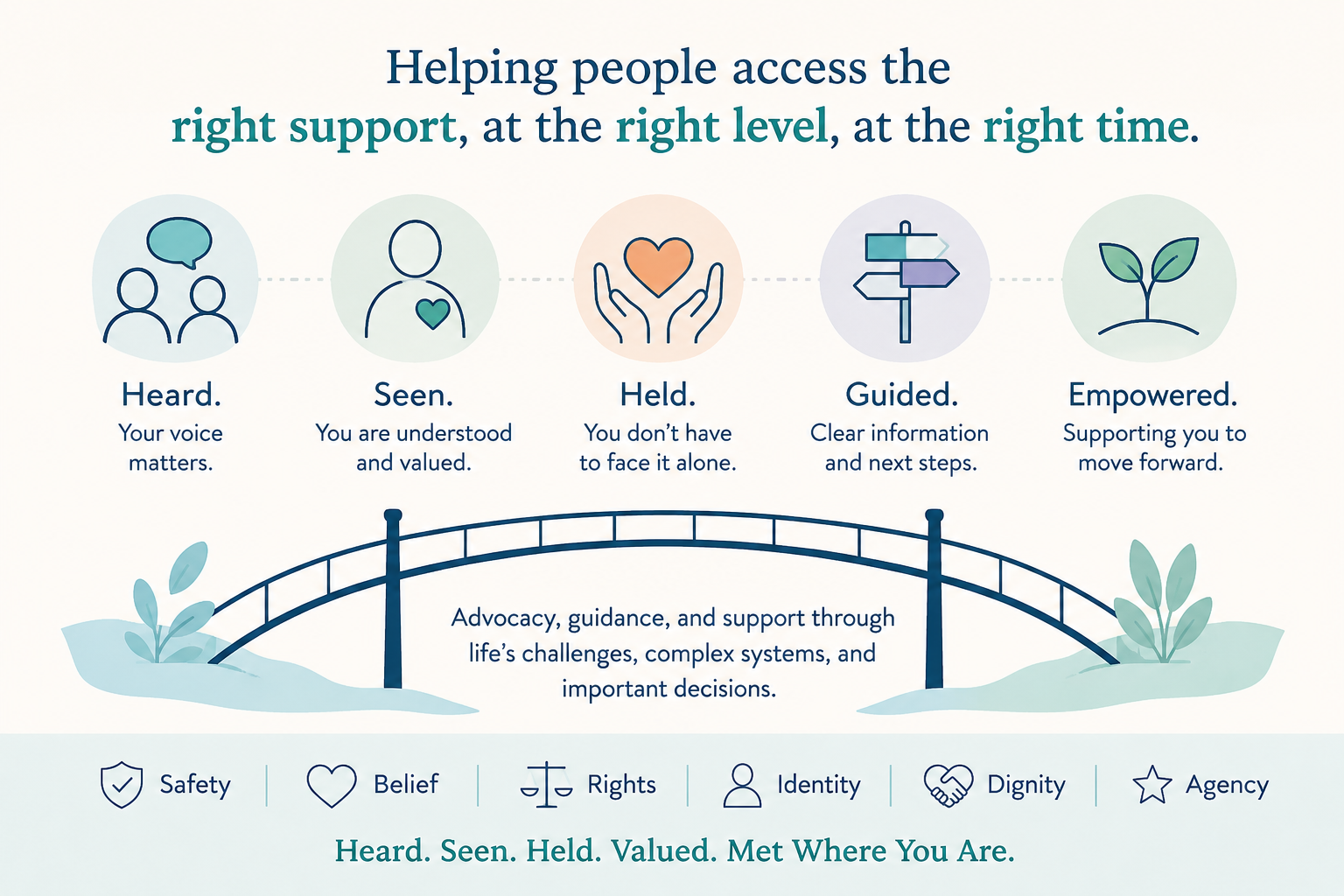
To help people access the right support, at the right level, at the right time.

By standing alongside people, strengthening communication, supporting informed decision-making, and helping people understand their options, we work to ensure individuals feel heard, seen, valued, and better able to move forward.

Our Approach

Advocacy Bridge provides structured, consent-led support that is collaborative, processing-aware, neurodivergent-informed, and focused on participation, communication, and accessibility.

We recognise that many systems rely on sustained organisation, communication, executive functioning, and processing capacity. During periods of stress, overwhelm, burnout, illness, disability, or increased life demands, these demands can become difficult to manage alone.

Our approach is informed by both professional experience and lived experience of neurodivergence and disability. We understand how overwhelming systems, decisions, communication, and day-to-day responsibilities can feel when things are unclear, unsupported, or moving too quickly.

Because of this, we work at a pace that is appropriate to the individual, providing structure, clarity, and practical support to help create calmer, more manageable pathways forward.

We aim to:

• Break complex situations into clear, manageable steps

• Present information in a structured and accessible way

• Repeat, clarify, or reframe information where helpful and without judgement

• Focus on realistic, achievable next steps that support progress without creating unnecessary overwhelm

• Use tools such as written notes, recordings, summaries, and structured follow-up to support continuity and understanding

• Help turn thoughts, concerns, and ideas into practical actions

• Support individuals to participate more effectively in decisions, conversations, and systems that affect their lives

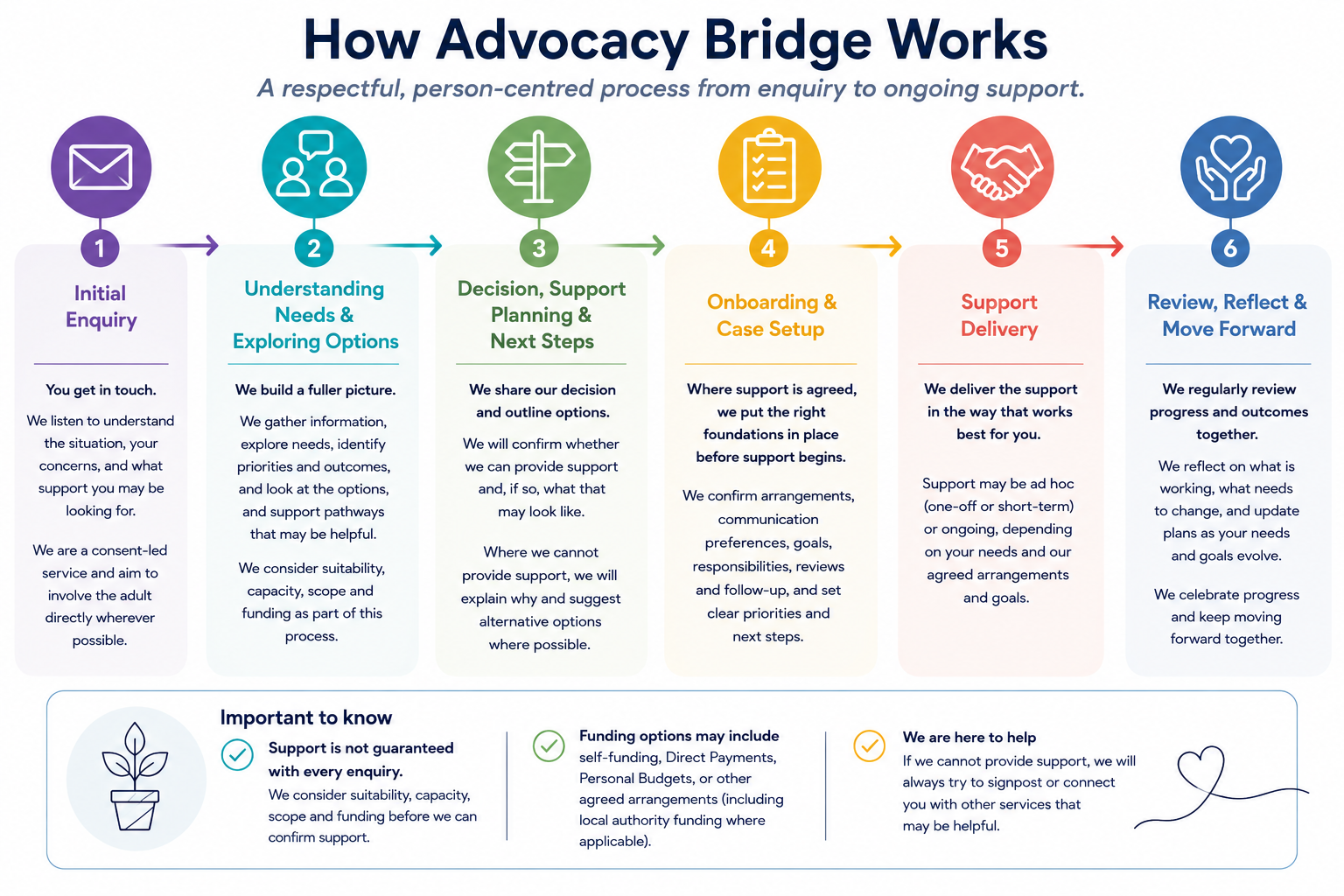
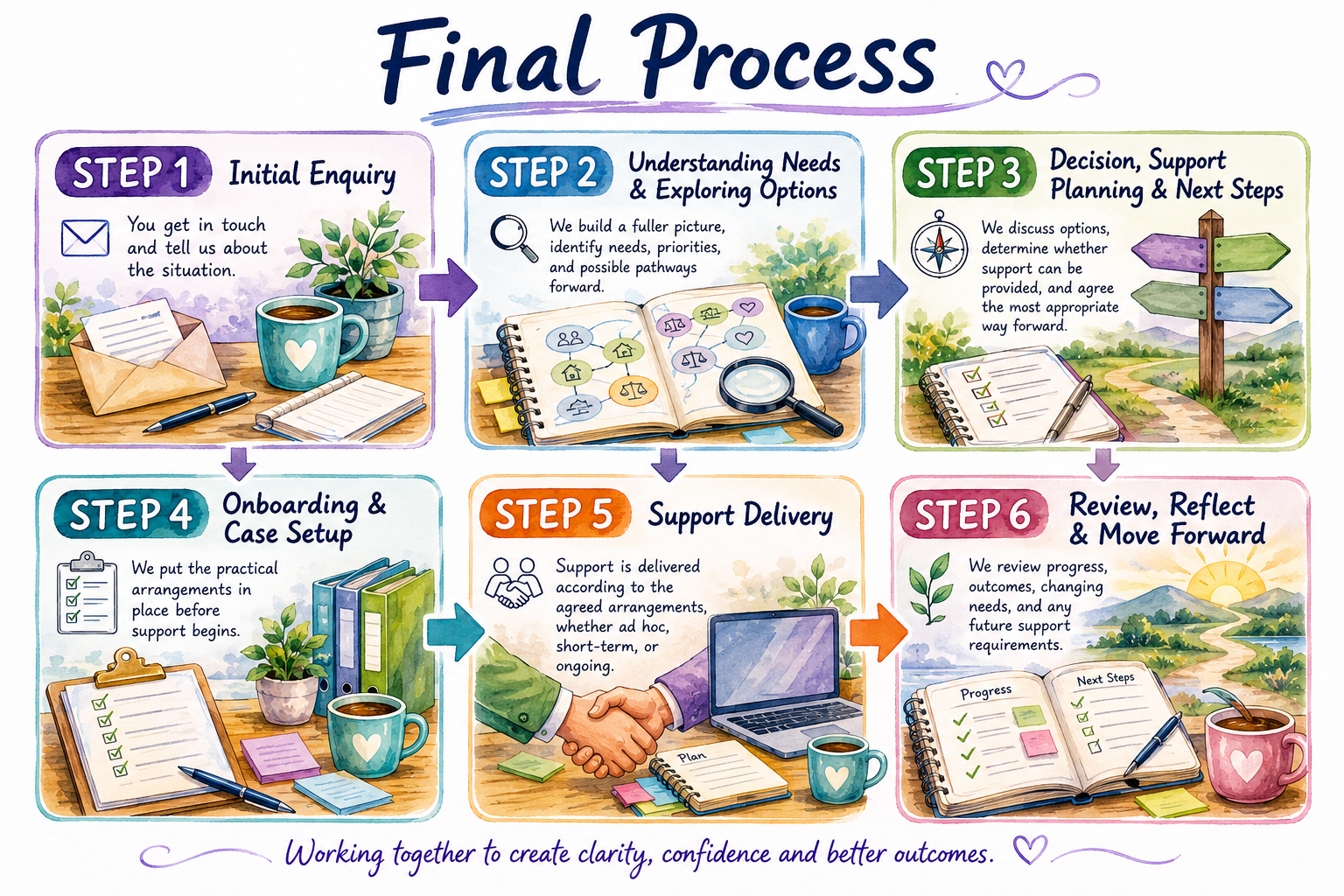
    Following the initial enquiry, we may work with the individual and, where appropriate, those involved in their support, to build a fuller understanding of the situation, identify priorities and needs, and explore possible options moving forward.

    Funding & Payment Options

    Support may be funded through private self-funding arrangements, Direct Payments, Personal Budgets, local authority commissioning, or other agreed funding arrangements where appropriate.

    Funding arrangements and eligibility requirements vary depending on individual circumstances and are discussed as part of the enquiry and assessment process.

    Please note that submitting an enquiry does not guarantee that Advocacy Bridge will be able to provide ongoing support.

    Before any support can be offered, we may need to consider factors such as the nature of the request, whether it falls within our scope of service, current availability and capacity, funding arrangements, and whether Advocacy Bridge is likely to be the most appropriate service for the individual’s needs.

    Where we are unable to offer ongoing support, we will aim to provide information, signposting, or alternative options where appropriate.

    The Advocacy Bridge Journey

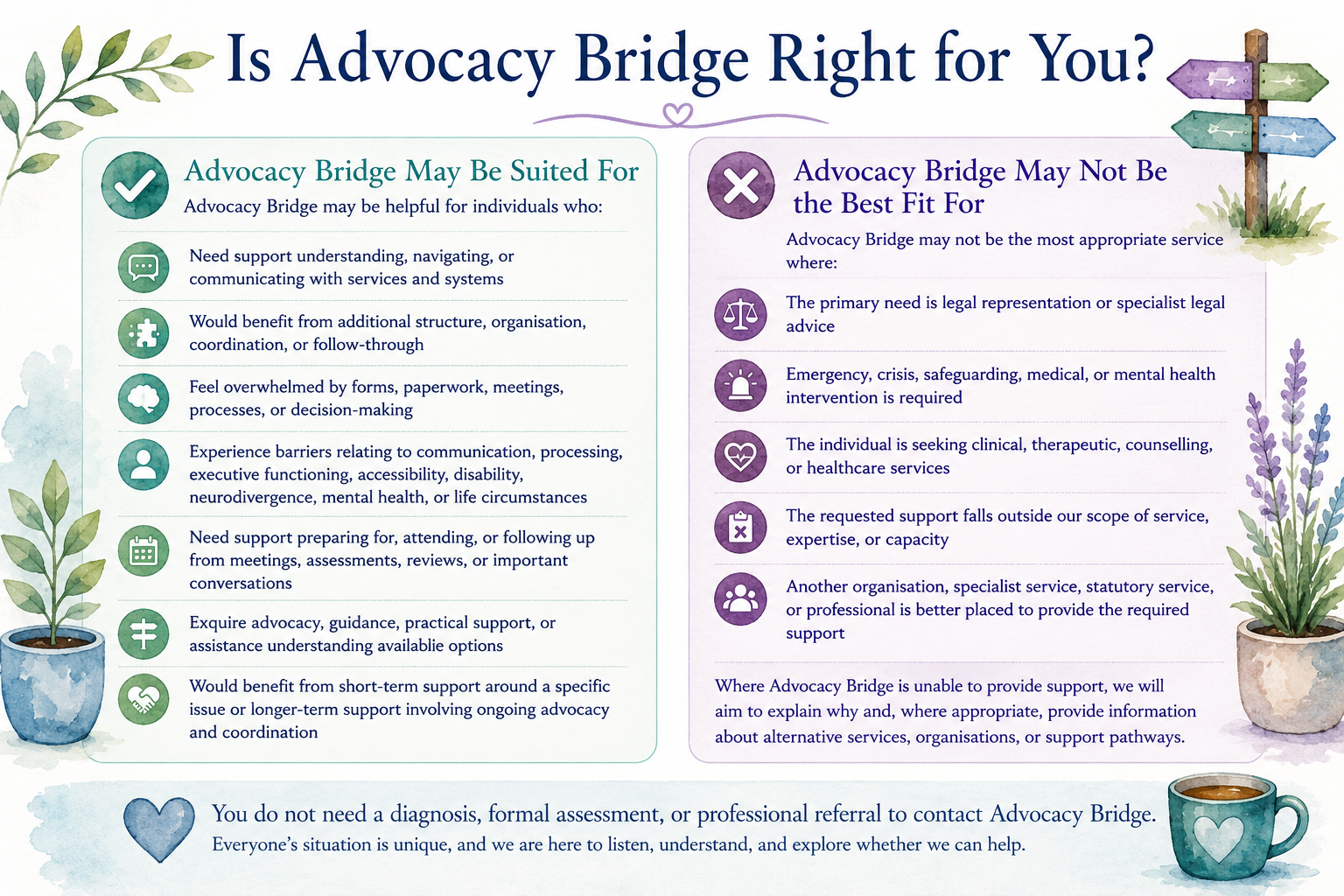
    Is Advocacy Bridge Right for You?

    Advocacy Bridge May Be Suited For

    Advocacy Bridge may be helpful for individuals who:

    • Need support understanding, navigating, or communicating with services and systems

    • Would benefit from additional structure, organisation, coordination, or follow-through

    • Feel overwhelmed by forms, paperwork, meetings, processes, or decision-making

    • Experience barriers relating to communication, processing, executive functioning, accessibility, disability, neurodivergence, mental health, or life circumstances

    • Need support preparing for, attending, or following up from meetings, assessments, reviews, or important conversations

    • Require advocacy, guidance, practical support, or assistance understanding available options

    • Would benefit from short-term support around a specific issue or longer-term support involving ongoing advocacy and coordination

    Advocacy Bridge May Not Be the Best Fit For

    Advocacy Bridge may not be the most appropriate service where:

    • The primary need is legal representation or specialist legal advice

    • Emergency, crisis, safeguarding, medical, or mental health intervention is required

    • The individual is seeking clinical, therapeutic, counselling, or healthcare services

    • The requested support falls outside our scope of service, expertise, or capacity

    • Another organisation, specialist service, statutory service, or professional is better placed to provide the required support

    Where Advocacy Bridge is unable to provide support, we will aim to explain why and, where appropriate, provide information about alternative services, organisations, or support pathways.

    What Happens After You Contact Us?

    Once we receive an enquiry or referral, we will review the information provided and make contact using the preferred communication method wherever possible.

    We may arrange a follow-up conversation to better understand the situation, current support in place, communication needs, and whether Advocacy Bridge is likely to be an appropriate fit.

    Some situations are straightforward, while others may require additional conversations, documents, or clarification before next steps can be identified.

    📨 We review your enquiry or referral.

    💬 We make contact using your preferred communication method.

    🔍 We gather any additional information needed.

    🧭 We explore possible options and next steps.

    🤝 Where appropriate, we discuss support arrangements.

    As Featured in Your Autism Magazine

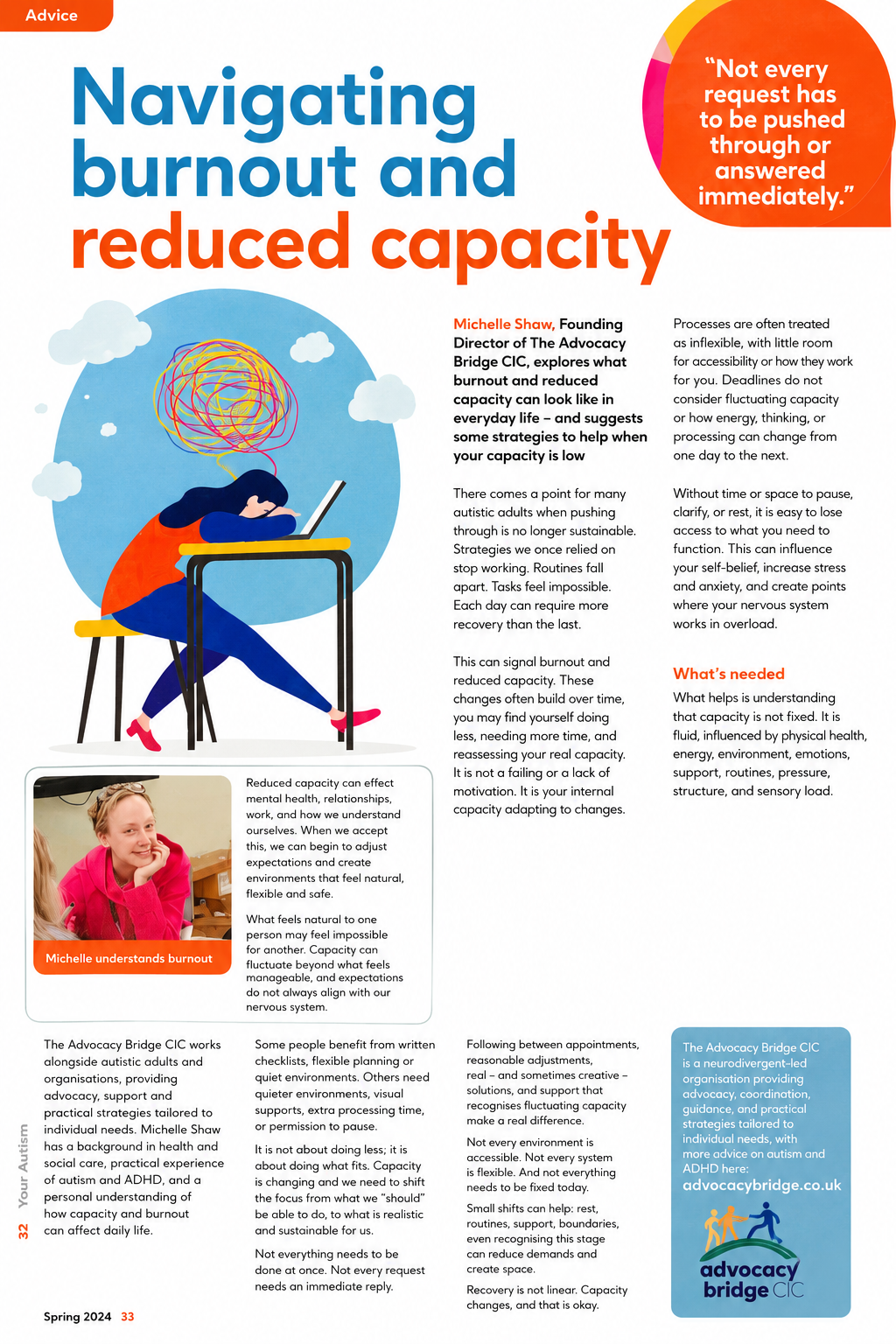
    Michelle Shaw, Founder of Advocacy Bridge, was featured in the Spring edition of Your Autism magazine with her article “Navigating Burnout and Reduced Capacity.”

    Drawing on both professional and lived experience, Michelle explores how burnout, fluctuating capacity, and overwhelm can affect autistic adults, alongside practical strategies for navigating periods of reduced capacity with greater understanding and self-compassion.

    Key Topics Discussed

    • Burnout and reduced capacity

    • Executive functioning and processing demands

    • Communication, accessibility, and support needs

    • Self-compassion and realistic expectations

    • Sustainable approaches to everyday life


    Why Advocacy Bridge Was Created

    The experiences discussed in this article reflect many of the challenges faced by the individuals who contact Advocacy Bridge.

    Our work is built around helping people navigate systems, communicate effectively, access support, and move forward in ways that are realistic, manageable, and tailored to their circumstances.

    What They Don’t Tell You 🎭

    What They Don’t Tell You 🎭

    A Letter to the Late-Diagnosed Woman in the Middle of Everything

    Dear you,

    You were probably the one who held it all together.

    The capable employee. 🧠
    The loyal partner. 💍
    The resourceful business owner. 💼
    The woman everyone relied on — even when no one really saw you.

    You didn’t just wear hats — you wore masks.
    And you wore them well. 🎭

    But what they don’t tell you is this:

    A late diagnosis doesn’t just explain your life.
    It quietly unravels it — not to break you, but to reveal you. ✨

    Because when you’ve built an entire identity around what was expected…
    …the moment you begin to unmask, the whole structure starts to shift.
    It’s like pulling back the curtain mid-performance and realising…
    🎶 “This isn’t my song.” 🎶
    And suddenly, you’re standing there — mic in hand — wondering who you are without the script.


    Employment: The Quiet Burnout 🔄

    At work, you were the steady one.
    The one who could do more with less.
    You didn’t ask for help because you didn’t think you were allowed to need it.

    Deadlines. Meetings. Smiles.
    Mask on. 🎭

    And now? You can’t.

    Not because you’re failing — but because your body finally said no more.

    What used to be effortless now feels insurmountable.
    Emails. CVs. Interviews. Conversations.
    Each one asks you to be a version of yourself that no longer exists.


    Marriage or Partnership: The Shape-Shifter 💔

    In relationships, you became what the moment needed.
    You soothed, supported, adapted, merged.

    You made it work — even when it chipped away at you.
    Because that’s what love looked like, right? Staying. Helping. Fixing. 💬

    But now you know:
    What you called love was often survival.

    You see where your needs were invisible.
    You feel the cost of being emotionally unsupported.

    And when you begin to unmask, those old dynamics no longer feel safe — or sustainable.
    The people closest to you don’t always recognise the real you coming forward.

    And that hurts more than most things.


    Business Ownership: The Exhausted Visionary 🔥

    You built something from scratch.
    You were driven, passionate, productive — until you weren’t.

    The truth?
    That business was built on burnout.
    On the version of you who kept going no matter what. 🚀

    Post-diagnosis, the business didn’t collapse — you did.

    Because your capacity changed.
    Because your nervous system could no longer tolerate the pace or pressure. ⚠️

    Now, even the idea of showing up publicly feels heavy.
    But your creativity hasn’t disappeared — it’s just waiting for a softer stage. 🎧


    The People Around You: Holding Expectations of a Past Self 👥

    They saw the capable you.
    The performing you.
    The version of you who always said yes, even when it hurt.

    So when you start saying no — or asking for space — people don’t always understand.
    They miss the old you.
    You might miss her too — even though she was never the whole story.

    You’re not the problem.
    You’re simply changing in a world that still expects you to stay the same. 🔄


    The Diagnosis: The Quiet Revolution 🚪

    What they really don’t tell you is that a late diagnosis isn’t just an explanation — it’s a quiet revolution.

    It didn’t change the past.
    But it changed how I see it — and that changed everything.

    It revealed why work felt like walking through fog. 🌫️
    Why relationships were exhausting.
    Why your business, as much as you loved it, slowly drained the life out of you.

    It brought clarity.
    Not closure. Not healing. Just the start. 🎤


    The Body Keeps the Score — Until It Can’t Anymore 🧘‍♀️

    Decade after decade of suppression doesn’t vanish.
    It settles into the body.
    In your sleep. 😴
    Your skin.
    Your stomach.
    Your silence. 🤐

    This is what they don’t talk about:
    That healing isn’t just about understanding.
    It’s about releasing.

    Not just in your thoughts. Not in your journal.
    But from your nervous system.

    And when you find a way to do that — breath by breath —
    it doesn’t just change how you think.
    It changes how you live. 🌱

    Releasing it from your body might be the most powerful thing you ever do.


    This Is the Reckoning — and the Rebirth 🔁

    You’re not who you were.
    Because now, you’re becoming you.

    Not the employee.
    Not the partner.
    Not the brand.
    The real you — underneath it all.

    It’s scary. Lonely. Unfamiliar.
    But also… honest.
    Peaceful.
    Real.

    You don’t have to bounce back.
    You don’t have to prove anything.
    You don’t have to rush.

    You’re not starting from scratch — you’re starting from truth. 💡


    Final Thought

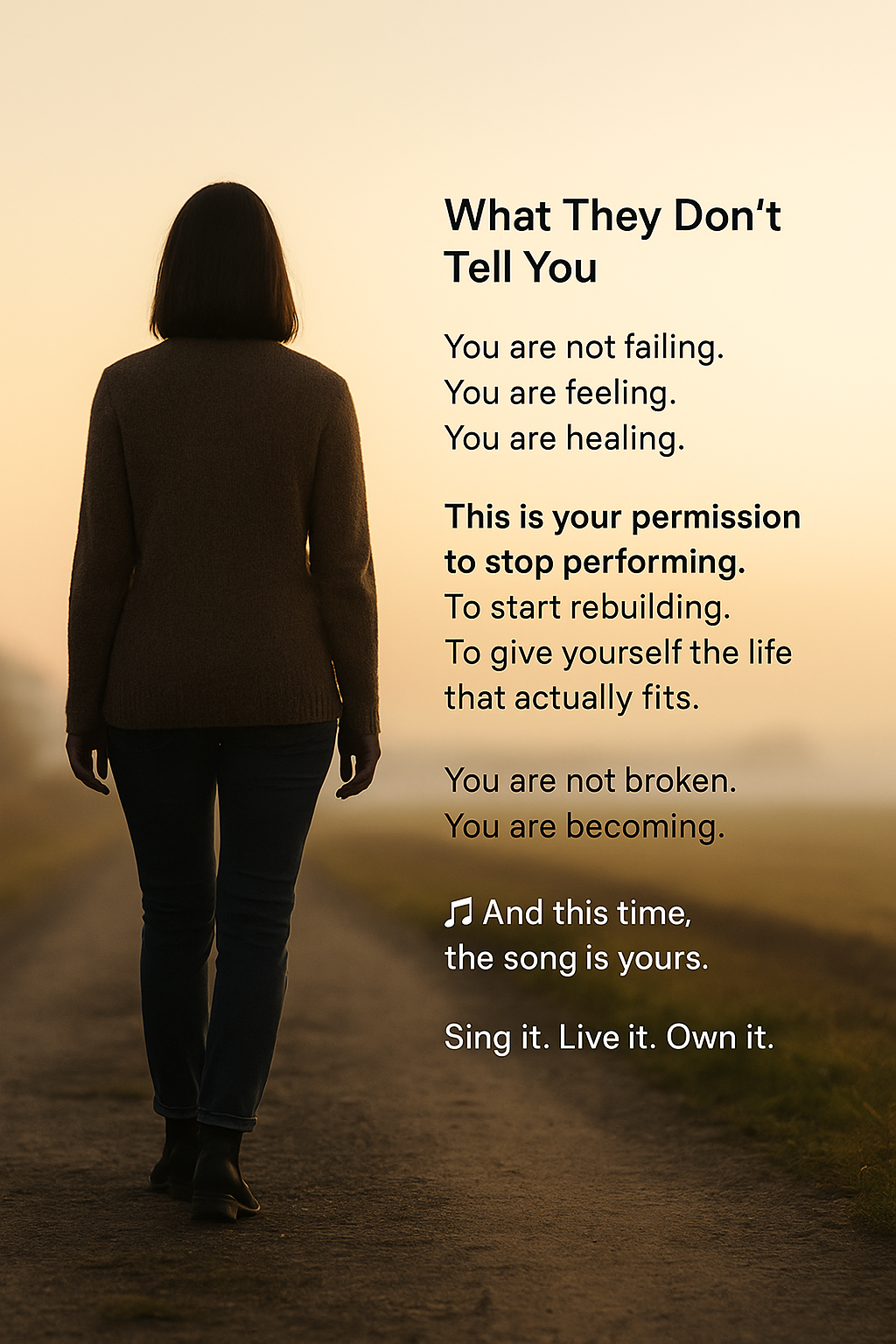
    You are not failing.
    You are feeling.
    You are healing. 🩷

    This is your permission to stop performing.
    To start rebuilding.
    To give yourself the life that actually fits.

    You are not broken.
    You are becoming.

    🎶 And this time, the song is yours. 🎶
    Sing it. Live it. Own it.

    With deep respect, love, and solidarity —
    from one woman still becoming,
    to every woman waking up in the middle of everything —
    and choosing herself anyway. 💌💫

    Michelle

    #LateDiagnosed #UnmaskingAutism #NeurodivergentWomen #LifeAfterDiagnosis #YouAreNotBroken #HealingIsntLinear #AuthenticLiving