People shouldn't have to prove their worth, learn how to ask for help, navigate complex systems, or wait for services to catch up before they can access the support they need.

Why Advocacy Bridge Exists


Advocacy Bridge exists to build a community of people, organisations, professionals, funders, and lived-experience voices committed to ensuring vulnerable people are heard, seen, held, valued, and met where they are—with dignity, compassion, and respect.

Together, we work to remove barriers, amplify voices, protect rights, and create pathways to support, safety, and self-determination.

Too often, people are expected to prove their worth, learn how to ask for help, and navigate systems that were not designed with their needs in mind before they can access the support they need.

Advocacy Bridge exists to help bridge that gap.

We believe people shouldn’t have to face difficult situations alone, wait until they reach crisis point, or lose confidence in themselves before support becomes available.

Our aim is simple:

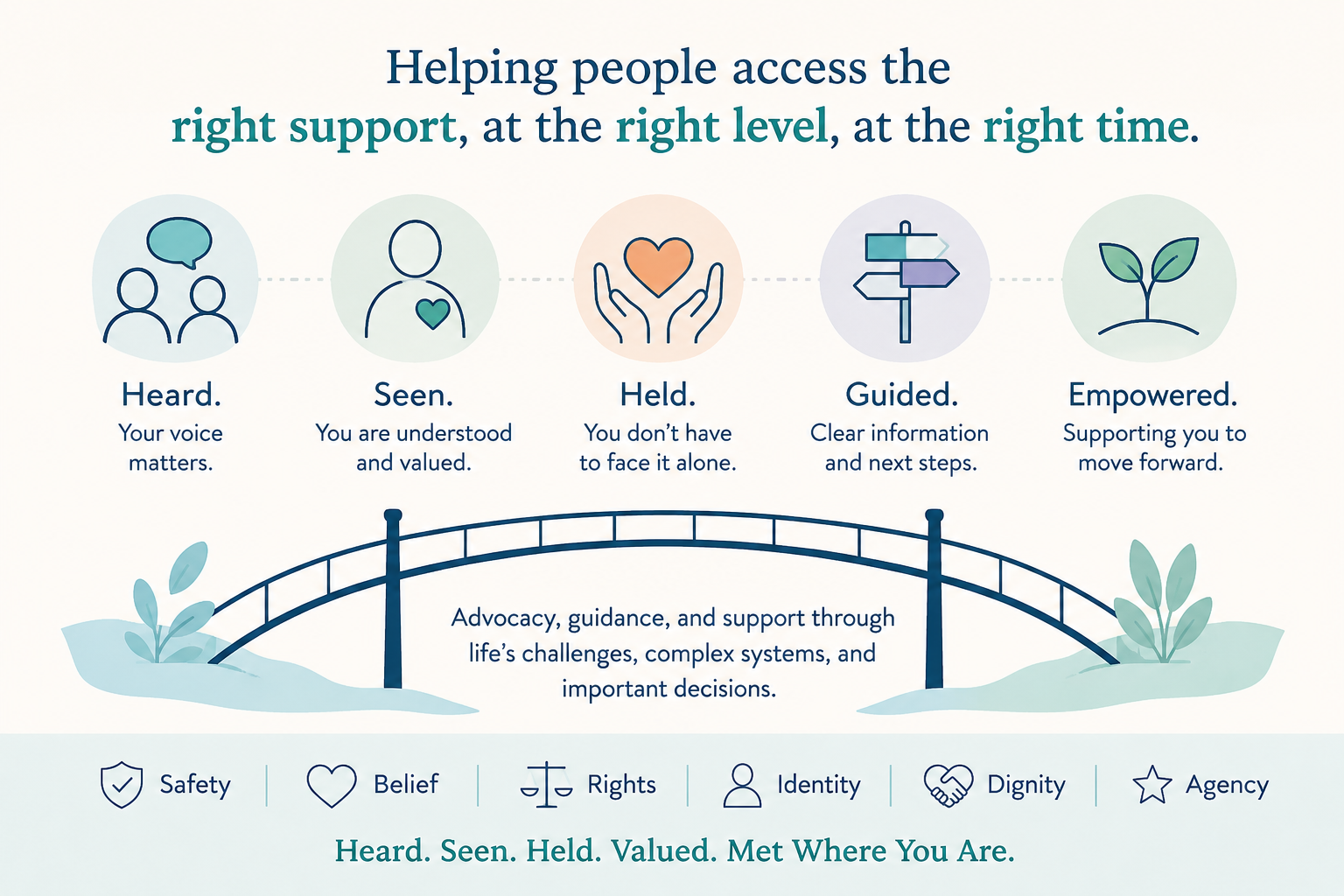
To help people access the right support, at the right level, at the right time.

By standing alongside people, strengthening communication, supporting informed decision-making, and helping people understand their options, we work to ensure individuals feel heard, seen, valued, and better able to move forward.

Our Approach

Advocacy Bridge provides structured, consent-led support that is collaborative, processing-aware, neurodivergent-informed, and focused on participation, communication, and accessibility.

We recognise that many systems rely on sustained organisation, communication, executive functioning, and processing capacity. During periods of stress, overwhelm, burnout, illness, disability, or increased life demands, these demands can become difficult to manage alone.

Our approach is informed by both professional experience and lived experience of neurodivergence and disability. We understand how overwhelming systems, decisions, communication, and day-to-day responsibilities can feel when things are unclear, unsupported, or moving too quickly.

Because of this, we work at a pace that is appropriate to the individual, providing structure, clarity, and practical support to help create calmer, more manageable pathways forward.

We aim to:

• Break complex situations into clear, manageable steps

• Present information in a structured and accessible way

• Repeat, clarify, or reframe information where helpful and without judgement

• Focus on realistic, achievable next steps that support progress without creating unnecessary overwhelm

• Use tools such as written notes, recordings, summaries, and structured follow-up to support continuity and understanding

• Help turn thoughts, concerns, and ideas into practical actions

• Support individuals to participate more effectively in decisions, conversations, and systems that affect their lives

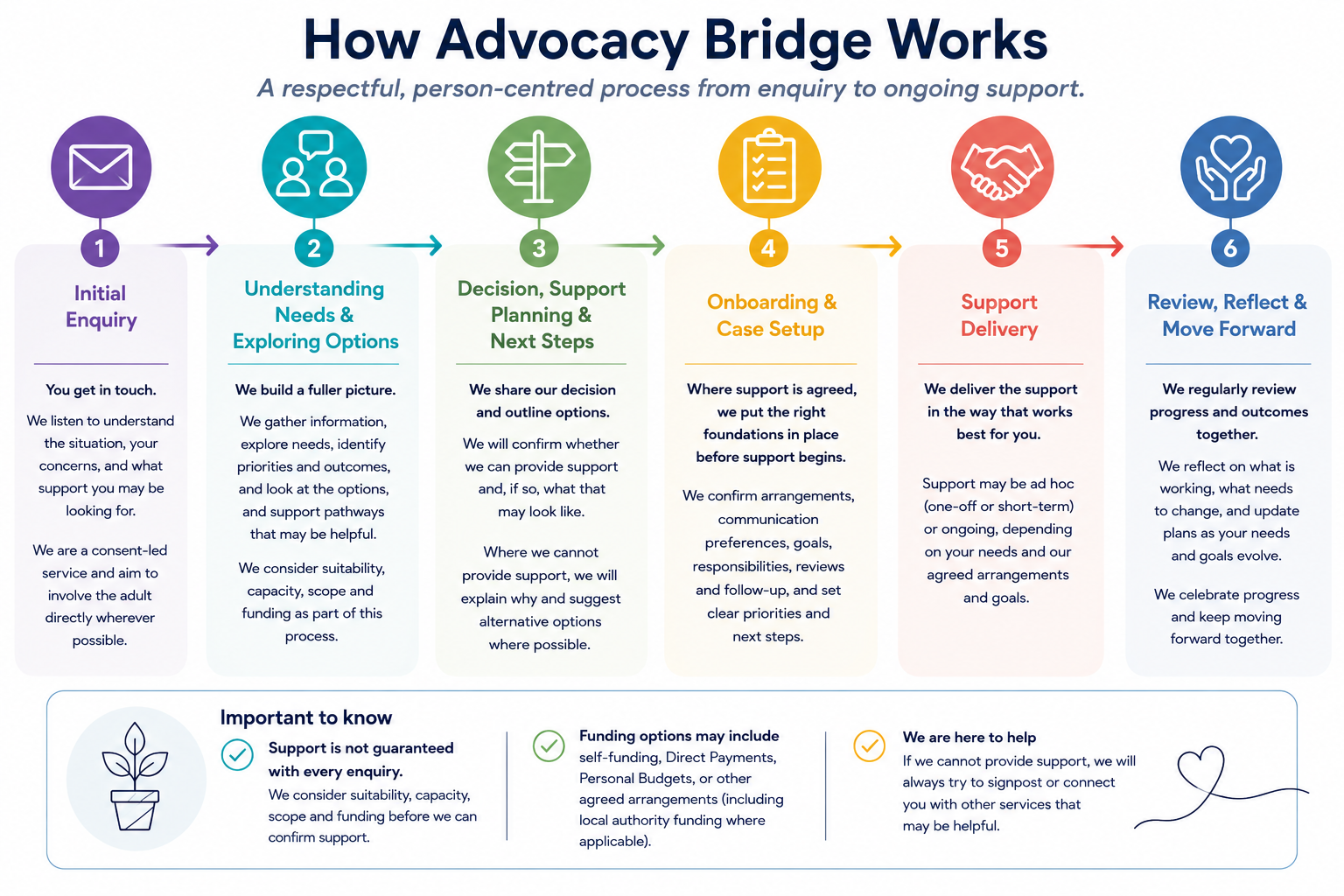
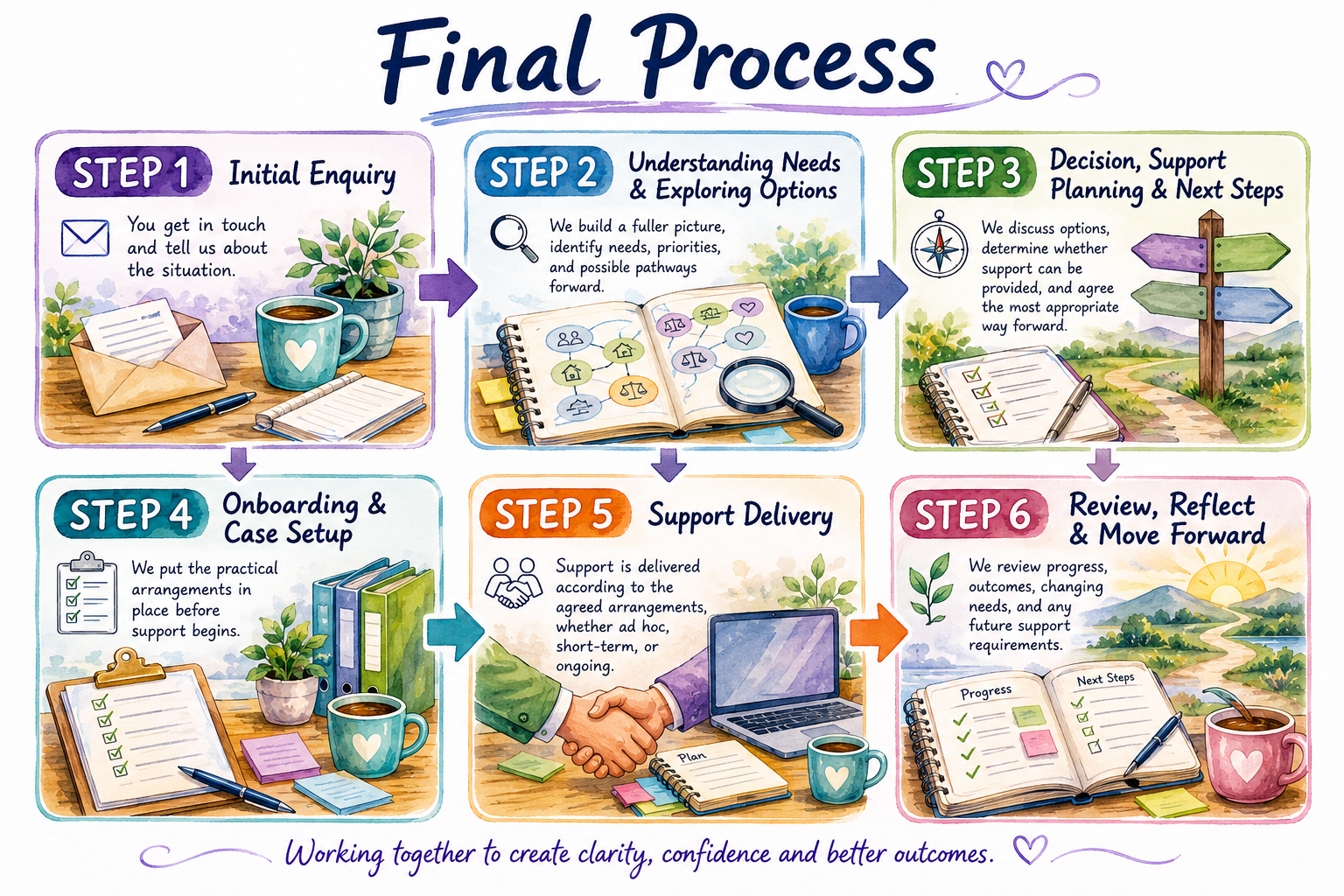
    Following the initial enquiry, we may work with the individual and, where appropriate, those involved in their support, to build a fuller understanding of the situation, identify priorities and needs, and explore possible options moving forward.

    Funding & Payment Options

    Support may be funded through private self-funding arrangements, Direct Payments, Personal Budgets, local authority commissioning, or other agreed funding arrangements where appropriate.

    Funding arrangements and eligibility requirements vary depending on individual circumstances and are discussed as part of the enquiry and assessment process.

    Please note that submitting an enquiry does not guarantee that Advocacy Bridge will be able to provide ongoing support.

    Before any support can be offered, we may need to consider factors such as the nature of the request, whether it falls within our scope of service, current availability and capacity, funding arrangements, and whether Advocacy Bridge is likely to be the most appropriate service for the individual’s needs.

    Where we are unable to offer ongoing support, we will aim to provide information, signposting, or alternative options where appropriate.

    The Advocacy Bridge Journey

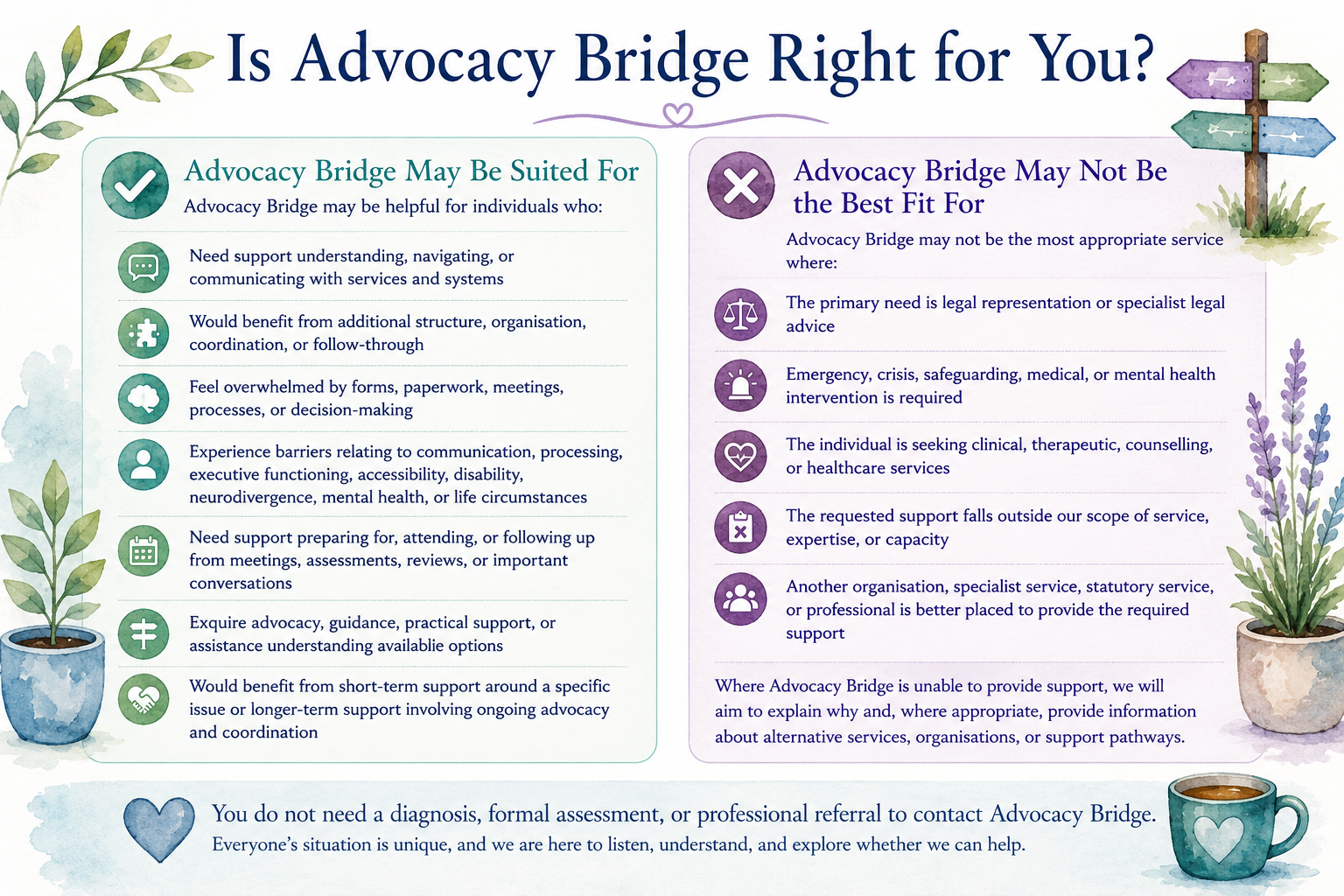
    Is Advocacy Bridge Right for You?

    Advocacy Bridge May Be Suited For

    Advocacy Bridge may be helpful for individuals who:

    • Need support understanding, navigating, or communicating with services and systems

    • Would benefit from additional structure, organisation, coordination, or follow-through

    • Feel overwhelmed by forms, paperwork, meetings, processes, or decision-making

    • Experience barriers relating to communication, processing, executive functioning, accessibility, disability, neurodivergence, mental health, or life circumstances

    • Need support preparing for, attending, or following up from meetings, assessments, reviews, or important conversations

    • Require advocacy, guidance, practical support, or assistance understanding available options

    • Would benefit from short-term support around a specific issue or longer-term support involving ongoing advocacy and coordination

    Advocacy Bridge May Not Be the Best Fit For

    Advocacy Bridge may not be the most appropriate service where:

    • The primary need is legal representation or specialist legal advice

    • Emergency, crisis, safeguarding, medical, or mental health intervention is required

    • The individual is seeking clinical, therapeutic, counselling, or healthcare services

    • The requested support falls outside our scope of service, expertise, or capacity

    • Another organisation, specialist service, statutory service, or professional is better placed to provide the required support

    Where Advocacy Bridge is unable to provide support, we will aim to explain why and, where appropriate, provide information about alternative services, organisations, or support pathways.

    What Happens After You Contact Us?

    Once we receive an enquiry or referral, we will review the information provided and make contact using the preferred communication method wherever possible.

    We may arrange a follow-up conversation to better understand the situation, current support in place, communication needs, and whether Advocacy Bridge is likely to be an appropriate fit.

    Some situations are straightforward, while others may require additional conversations, documents, or clarification before next steps can be identified.

    📨 We review your enquiry or referral.

    💬 We make contact using your preferred communication method.

    🔍 We gather any additional information needed.

    🧭 We explore possible options and next steps.

    🤝 Where appropriate, we discuss support arrangements.

    As Featured in Your Autism Magazine

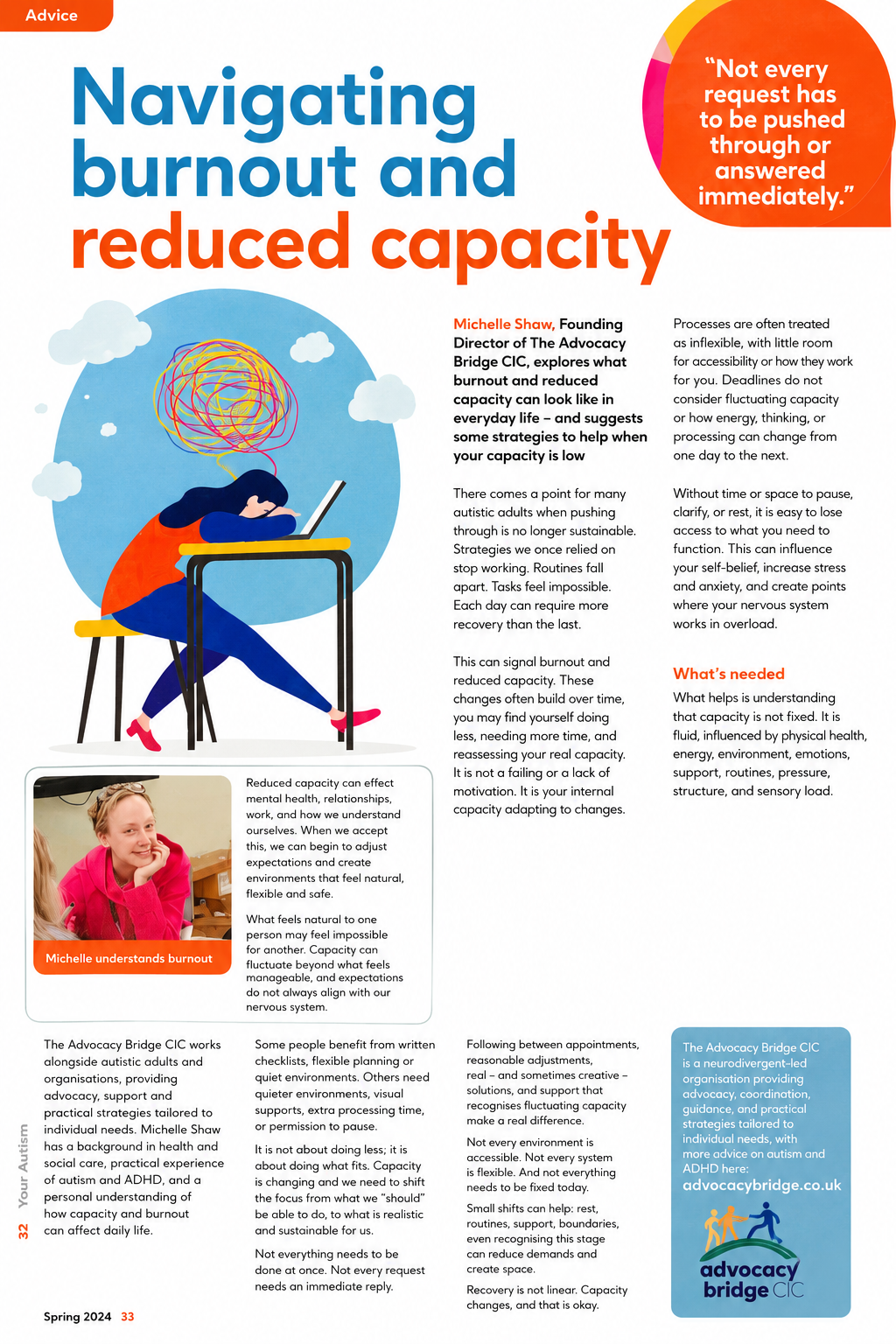
    Michelle Shaw, Founder of Advocacy Bridge, was featured in the Spring edition of Your Autism magazine with her article “Navigating Burnout and Reduced Capacity.”

    Drawing on both professional and lived experience, Michelle explores how burnout, fluctuating capacity, and overwhelm can affect autistic adults, alongside practical strategies for navigating periods of reduced capacity with greater understanding and self-compassion.

    Key Topics Discussed

    • Burnout and reduced capacity

    • Executive functioning and processing demands

    • Communication, accessibility, and support needs

    • Self-compassion and realistic expectations

    • Sustainable approaches to everyday life


    Why Advocacy Bridge Was Created

    The experiences discussed in this article reflect many of the challenges faced by the individuals who contact Advocacy Bridge.

    Our work is built around helping people navigate systems, communicate effectively, access support, and move forward in ways that are realistic, manageable, and tailored to their circumstances.

    What Coaching Is (and Isn’t)

    What Coaching Is (and Isn’t): Choosing the Right Support

    What Is Coaching?

    Coaching is all about helping you move forward. It’s a future-focused partnership where we work together to:

    • Clarify what you want and what’s holding you back.
    • Find practical solutions and take meaningful steps forward.
    • Build confidence and create positive change in your life.

    Think of it as unlocking your potential by focusing on what you can do now to create the life you want.


    What Coaching Isn’t

    Let’s be clear—coaching isn’t therapy, counselling, or medical care. It’s not about diagnosing or treating mental health conditions. Instead, it’s about empowering you to take action and move toward your goals.


    How Does Coaching Compare to Other Types of Support?

    If you’re wondering how coaching fits alongside other types of help, here’s a quick breakdown:

    • Counselling: Helps you process emotions, often linked to past experiences like trauma or grief.
    • Neurodivergent Counselling: Specifically supports individuals with Autism, ADHD, or other conditions, tailored to their unique challenges.
    • Psychiatry: Focuses on medical diagnosis and treatment, including medication, for mental health conditions like severe anxiety or ADHD.
    • Psychology: Uses evidence-based therapy (like CBT or DBT) to address mental health concerns, behaviours, or patterns.

    Who Might Benefit from Coaching?

    Coaching might be right for you if:

    • You’re feeling stuck or unsure about what’s next.
    • You need clarity and direction to move forward.
    • You’re ready for practical strategies to create change in your life, relationships, or business.

    Who Might Need Other Types of Support?

    It’s also important to recognise when other forms of support might be more helpful:

    • Counselling or Therapy: If you’re working through intense emotions, trauma, or grief.
    • Neurodivergent Counselling: If you need support navigating life with Autism, ADHD, or similar conditions.
    • Psychiatry: If mental health is significantly affecting your day-to-day life and might require medical intervention.
    • Psychology: If you’d like therapy to address deeper patterns or behaviours that impact your mental health.

    Not Sure What You Need?

    It’s okay to feel unsure—it can be hard to know what kind of support is best. Here’s a simple way to think about it:

    • Choose Coaching: If you want clarity, options, practical steps, and support for the present and future.
    • Choose Counselling or Therapy: If you’re working through emotions or past experiences.
    • Choose Medical or Psychological Care: If mental health symptoms are interfering with your daily life.

    Why Coaching Might Be Right for You

    Coaching could be the perfect fit if you’re ready to:

    • Focus on solutions rather than problems.
    • Take small, meaningful steps toward your goals.
    • Be supported in a safe, non-judgemental space where you can explore what matters most to you.

    Let’s Take That First Step Together

    💬 Still unsure? That’s okay! Starting with just one coaching session can help you gain clarity and decide what’s right for you. You don’t have to figure it out alone.

    If you’re ready to move forward, let’s chat—I’d love to help you explore what’s next.

    👉 Book Your First Step Session