People shouldn't have to prove their worth, learn how to ask for help, navigate complex systems, or wait for services to catch up before they can access the support they need.

Why Advocacy Bridge Exists


Advocacy Bridge exists to build a community of people, organisations, professionals, funders, and lived-experience voices committed to ensuring vulnerable people are heard, seen, held, valued, and met where they are—with dignity, compassion, and respect.

Together, we work to remove barriers, amplify voices, protect rights, and create pathways to support, safety, and self-determination.

Too often, people are expected to prove their worth, learn how to ask for help, and navigate systems that were not designed with their needs in mind before they can access the support they need.

Advocacy Bridge exists to help bridge that gap.

We believe people shouldn’t have to face difficult situations alone, wait until they reach crisis point, or lose confidence in themselves before support becomes available.

Our aim is simple:

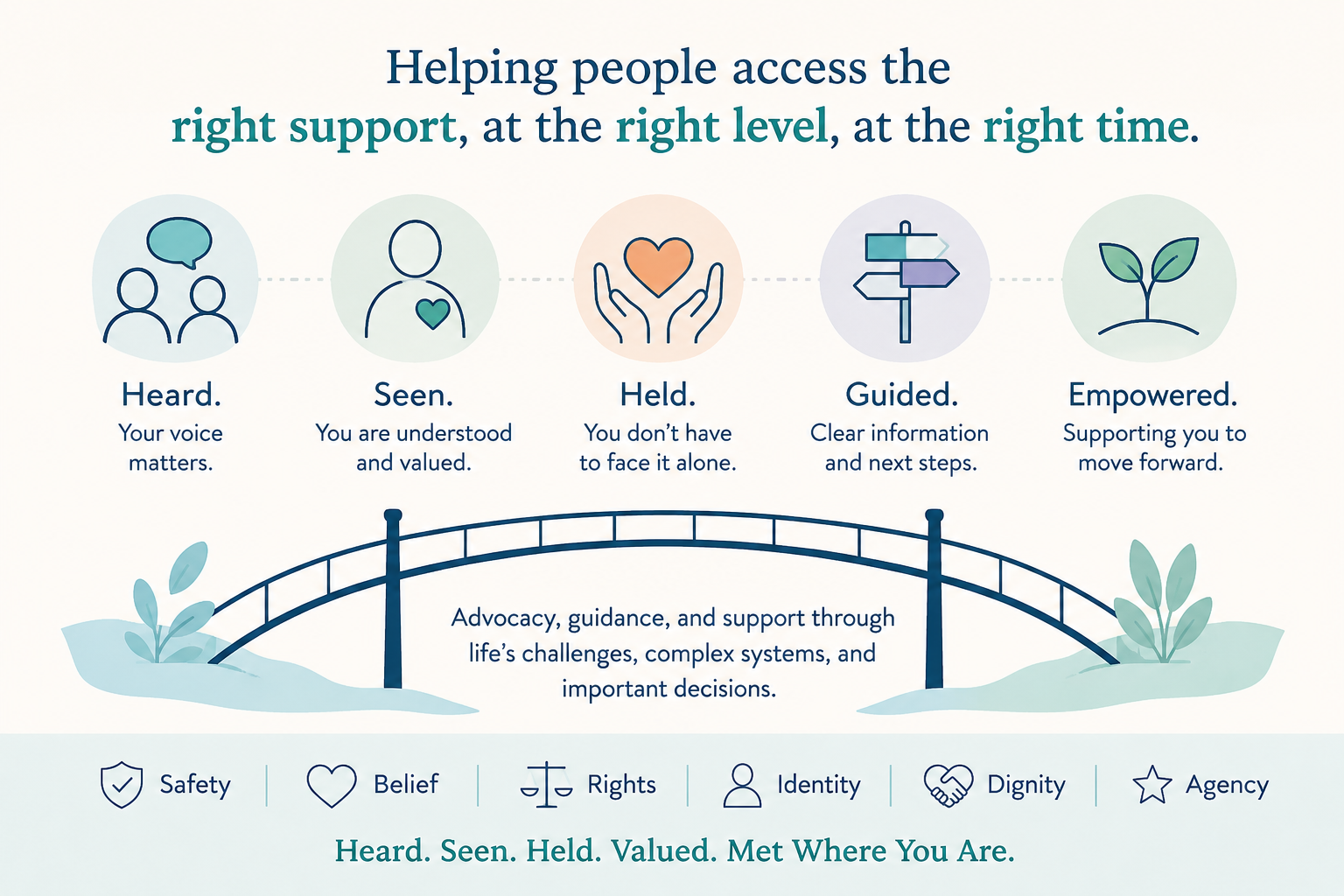
To help people access the right support, at the right level, at the right time.

By standing alongside people, strengthening communication, supporting informed decision-making, and helping people understand their options, we work to ensure individuals feel heard, seen, valued, and better able to move forward.

Our Approach

Advocacy Bridge provides structured, consent-led support that is collaborative, processing-aware, neurodivergent-informed, and focused on participation, communication, and accessibility.

We recognise that many systems rely on sustained organisation, communication, executive functioning, and processing capacity. During periods of stress, overwhelm, burnout, illness, disability, or increased life demands, these demands can become difficult to manage alone.

Our approach is informed by both professional experience and lived experience of neurodivergence and disability. We understand how overwhelming systems, decisions, communication, and day-to-day responsibilities can feel when things are unclear, unsupported, or moving too quickly.

Because of this, we work at a pace that is appropriate to the individual, providing structure, clarity, and practical support to help create calmer, more manageable pathways forward.

We aim to:

• Break complex situations into clear, manageable steps

• Present information in a structured and accessible way

• Repeat, clarify, or reframe information where helpful and without judgement

• Focus on realistic, achievable next steps that support progress without creating unnecessary overwhelm

• Use tools such as written notes, recordings, summaries, and structured follow-up to support continuity and understanding

• Help turn thoughts, concerns, and ideas into practical actions

• Support individuals to participate more effectively in decisions, conversations, and systems that affect their lives

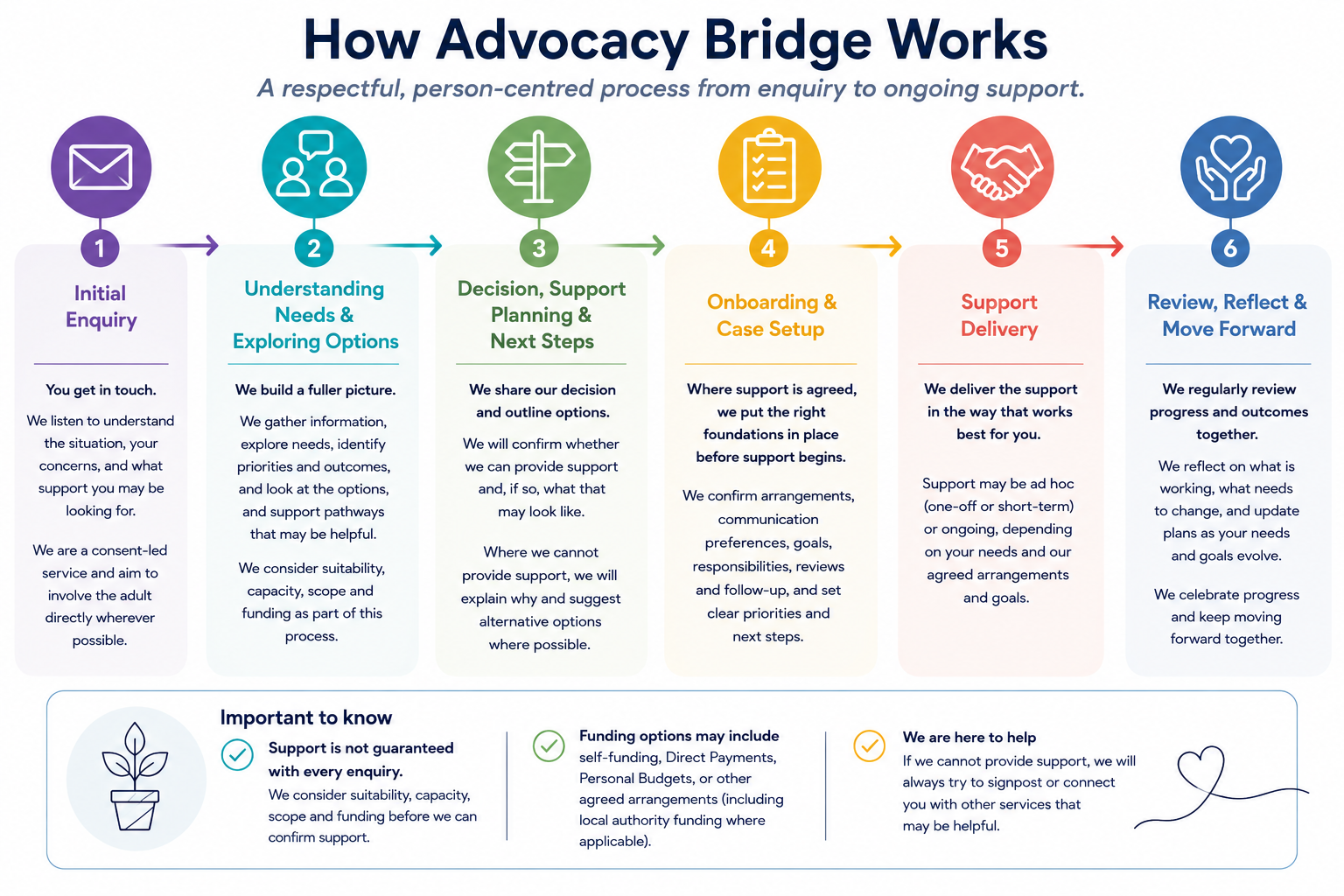
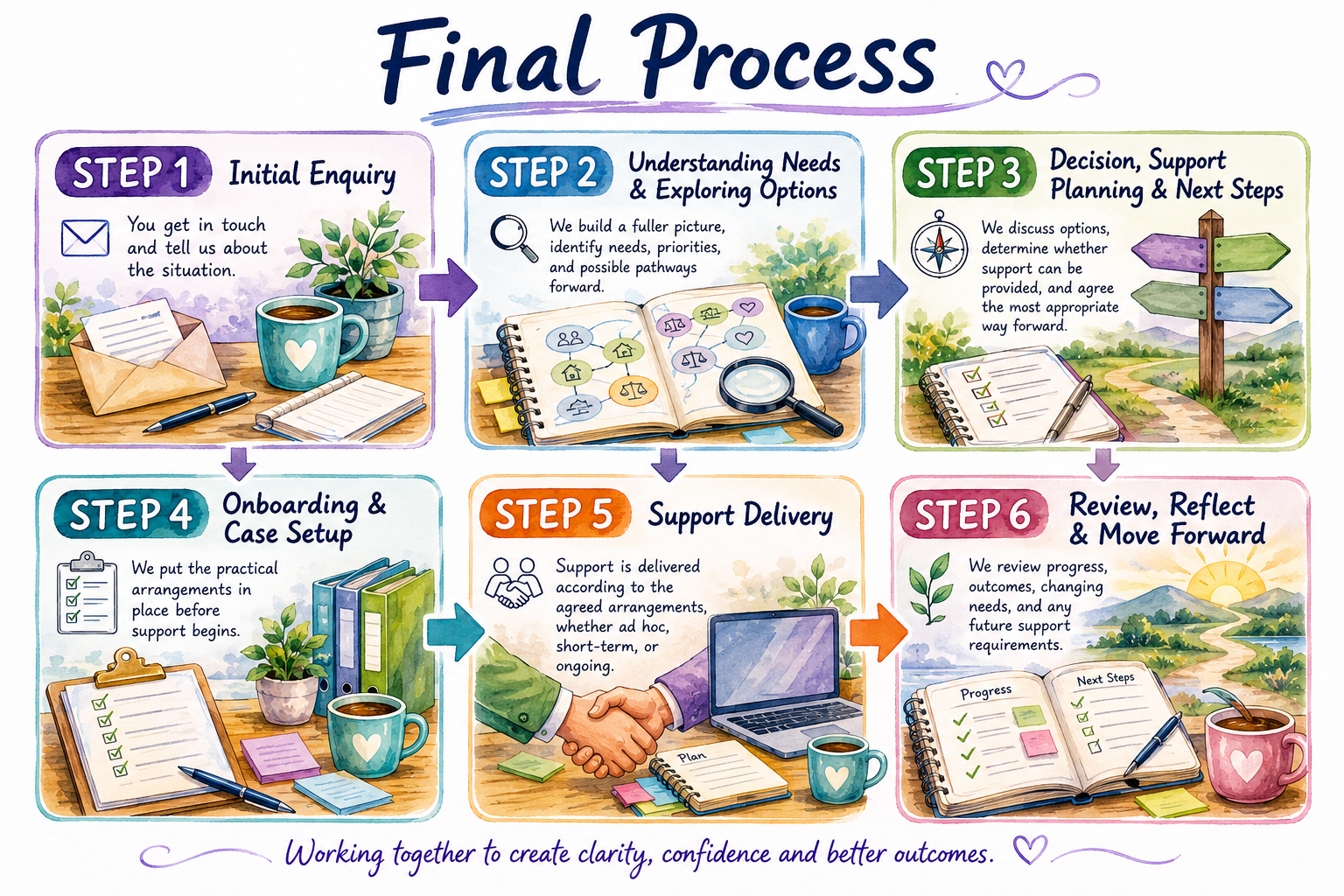
    Following the initial enquiry, we may work with the individual and, where appropriate, those involved in their support, to build a fuller understanding of the situation, identify priorities and needs, and explore possible options moving forward.

    Funding & Payment Options

    Support may be funded through private self-funding arrangements, Direct Payments, Personal Budgets, local authority commissioning, or other agreed funding arrangements where appropriate.

    Funding arrangements and eligibility requirements vary depending on individual circumstances and are discussed as part of the enquiry and assessment process.

    Please note that submitting an enquiry does not guarantee that Advocacy Bridge will be able to provide ongoing support.

    Before any support can be offered, we may need to consider factors such as the nature of the request, whether it falls within our scope of service, current availability and capacity, funding arrangements, and whether Advocacy Bridge is likely to be the most appropriate service for the individual’s needs.

    Where we are unable to offer ongoing support, we will aim to provide information, signposting, or alternative options where appropriate.

    The Advocacy Bridge Journey

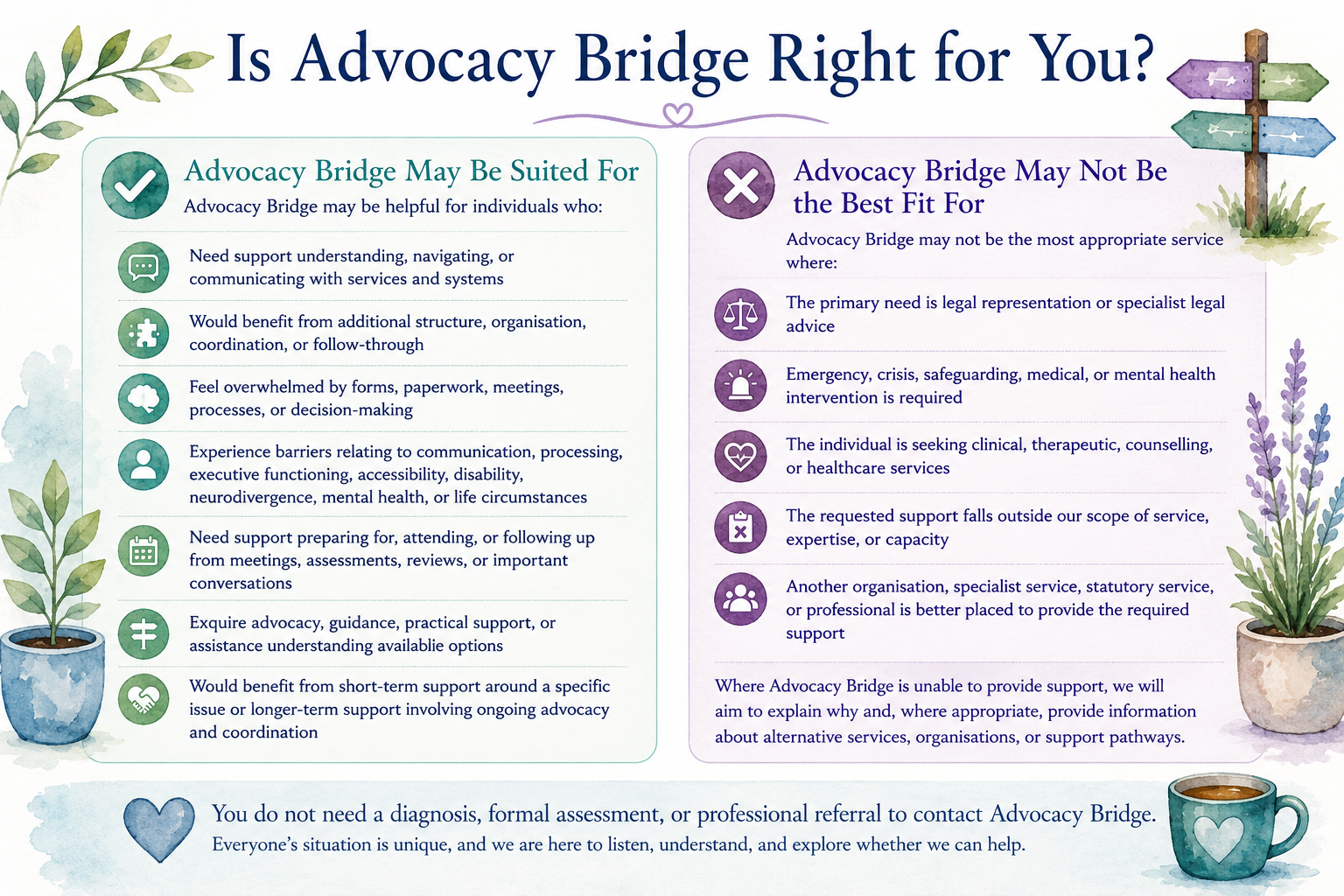
    Is Advocacy Bridge Right for You?

    Advocacy Bridge May Be Suited For

    Advocacy Bridge may be helpful for individuals who:

    • Need support understanding, navigating, or communicating with services and systems

    • Would benefit from additional structure, organisation, coordination, or follow-through

    • Feel overwhelmed by forms, paperwork, meetings, processes, or decision-making

    • Experience barriers relating to communication, processing, executive functioning, accessibility, disability, neurodivergence, mental health, or life circumstances

    • Need support preparing for, attending, or following up from meetings, assessments, reviews, or important conversations

    • Require advocacy, guidance, practical support, or assistance understanding available options

    • Would benefit from short-term support around a specific issue or longer-term support involving ongoing advocacy and coordination

    Advocacy Bridge May Not Be the Best Fit For

    Advocacy Bridge may not be the most appropriate service where:

    • The primary need is legal representation or specialist legal advice

    • Emergency, crisis, safeguarding, medical, or mental health intervention is required

    • The individual is seeking clinical, therapeutic, counselling, or healthcare services

    • The requested support falls outside our scope of service, expertise, or capacity

    • Another organisation, specialist service, statutory service, or professional is better placed to provide the required support

    Where Advocacy Bridge is unable to provide support, we will aim to explain why and, where appropriate, provide information about alternative services, organisations, or support pathways.

    What Happens After You Contact Us?

    Once we receive an enquiry or referral, we will review the information provided and make contact using the preferred communication method wherever possible.

    We may arrange a follow-up conversation to better understand the situation, current support in place, communication needs, and whether Advocacy Bridge is likely to be an appropriate fit.

    Some situations are straightforward, while others may require additional conversations, documents, or clarification before next steps can be identified.

    📨 We review your enquiry or referral.

    💬 We make contact using your preferred communication method.

    🔍 We gather any additional information needed.

    🧭 We explore possible options and next steps.

    🤝 Where appropriate, we discuss support arrangements.

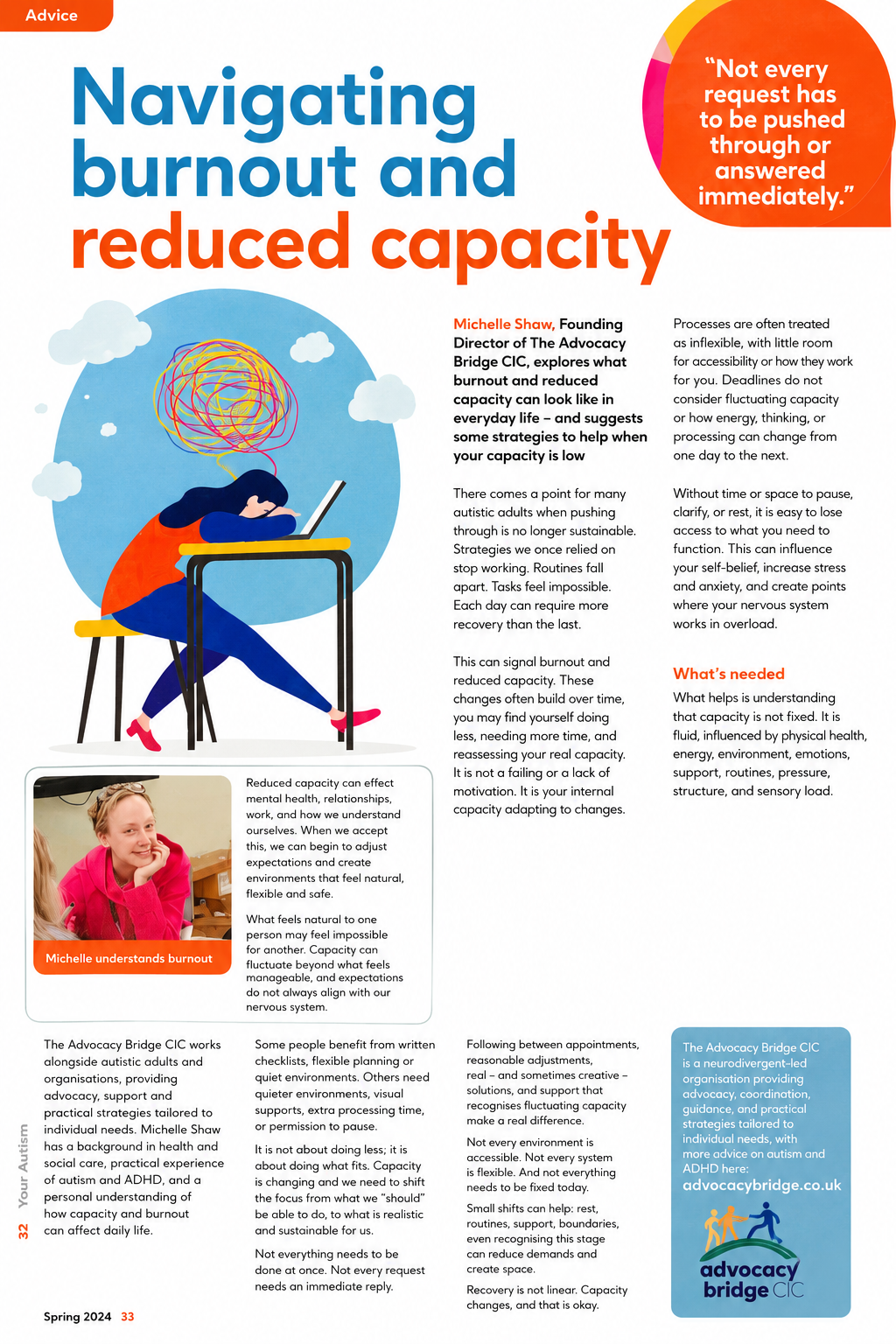
    As Featured in Your Autism Magazine

    Michelle Shaw, Founder of Advocacy Bridge, was featured in the Spring edition of Your Autism magazine with her article “Navigating Burnout and Reduced Capacity.”

    Drawing on both professional and lived experience, Michelle explores how burnout, fluctuating capacity, and overwhelm can affect autistic adults, alongside practical strategies for navigating periods of reduced capacity with greater understanding and self-compassion.

    Key Topics Discussed

    • Burnout and reduced capacity

    • Executive functioning and processing demands

    • Communication, accessibility, and support needs

    • Self-compassion and realistic expectations

    • Sustainable approaches to everyday life


    Why Advocacy Bridge Was Created

    The experiences discussed in this article reflect many of the challenges faced by the individuals who contact Advocacy Bridge.

    Our work is built around helping people navigate systems, communicate effectively, access support, and move forward in ways that are realistic, manageable, and tailored to their circumstances.

    Charting My Own Course: A Journey from Pain to Purpose

    For as long as I can remember, I’ve been determined to make the most of whatever life throws at me, and I love to be busy. I fell in love with music and dance at the age of 6, and by 12, I was already assisting as a dance teacher, working on reception, and occasionally teaching classes. Performing, teaching, and choreographing gave me a sense of purpose—a space where I thrived creatively and began collecting records.

    Even after breaking my leg, I spent three days in the hospital and gotten so bored of sitting and waiting, I needed to be back at work and did within two weeks—riding my new moped with crutches in tow, getting involved behind the scenes at the dance school, and helping organise music for annual shows and exams. I never knew a time when I couldn’t just pick myself up and dust myself off.

    Looking back, I can see where my passion for being part of a team comes from—being part of the magic behind the scenes. It’s a perfect fit for my Autistic heart!

    Life in Mum’s bubble was a joy—time spent together was something I always looked forward to. Whether it was going to the cash and carry, grabbing coffee at Morrisons, meeting up with her Doggie friends, or helping out at her Dog Club, we shared so many hours together. She made life easy for me and even helped me set up for my DJ gigs. I loved playing some of her favourite songs during soundcheck, and we always had the best chats. There wasn’t a single moment we spent together where I didn’t feel unconditionally loved, understood, and accepted. I felt respected and valued with every minute we shared.

    Family life was never the same after Mum died. Her passing catapulted me into the deepest void I had ever known. On the day of her funeral, Dad told me it would be ‘work as usual tomorrow,’ and that we had to ‘just get on with things.’ I didn’t fully understand what that meant at the time and brushed it off, as I was still holding on to the feeling of us all working together as a team. But everything changed after the funeral.

    Despite my efforts to connect with my family the way I had with Mum, I found myself attracting more drama and conflict. I lacked the tools to understand my reality and assumed I could get along with everyone as I had with her, believing I could explore, express, or process my grief. But I hadn’t even begun to process what I had truly lost. The harder I tried to build connections with everyone, the more painful, awkward, confusing, and deeply conflicting it became. Nothing made sense. I began to feel foolish for even having thoughts and feelings, let alone sharing them.

    By the age of 37, I still didn’t have a clear understanding of my situation. I even called Childline for help, but they refused to support me because, in their eyes, I was an adult. My family needed me to ‘grow up,’ and I needed to stand up for myself, but I was outnumbered, overruled, and constantly compared to my younger sister, who just wanted a ‘normal sister.’ Years of prolonged emotional isolation, dysregulation, and a deep psychological abyss left me feeling like I was never good enough as a daughter, sister, or later, an aunt. I grew up believing this was normal in family life.

    Being born in the seventies and coming of age in the noughties, some might see this as a disadvantage. But I’ve always believed that everything happens for a reason, and I’ve maintained a strong philosophical perspective, gaining immense clarity through writing out my thoughts and feelings. Watching how other families interacted and supported each other emotionally and psychologically reaffirmed what I already knew—the deep, meaningful connection I had with my mother was real. Every positive interaction I observed in other families validated that bond and became like my favourite kind of movie. I learned so much by listening to their conversations and observing how they responded to one another in the moment. I couldn’t get enough of watching their interactions, yet all the while, my own ‘movie’ felt stuck on a loop and shaped my worldview.

    I didn’t have the tools to fully recognise what was happening as I wasn’t in full view of the facts or reality of my situation and had no authorised access to the truth. I was undiagnosed and not self-aware or educated about boundaries unlike now—but imagine if I had been back then? It wouldn’t have been possible for me to tolerate or accept everything, nor would I have waited until my Dad became so overwhelmed and angered to say, ‘If you are still here in ten years’ time, I will resent you.’ That moment jolted me into action. Living without self-awareness, boundaries and authority over my own life led to that pivotal moment, sparking an introspective journey that would reshape the course of my life. Within two weeks, I had given notice to my tenants and was back in my own home, waking up on my 40th birthday in my own space.

    Project ME became my sole focus—who I wanted to become, who I wanted to work for, and how to transform my entire life. This chapter was the most exciting and empowering I’d ever known. Reclaiming control and gaining clarity about what I truly wanted for my future became my most important project, and I never felt bored again. Each day was filled with optimism and hope, bursting with new ideas, thoughts, and feelings. Every minute became an opportunity to reflect or take action on improving my life, relationships, and work. I embraced every part of the process, setting out to create a life that aligned with how I truly wanted to feel. In January 2008, while on sick leave from work, I made the bold decision to leave everything and everyone behind to live life on my own terms, at sea.

    I’m eternally grateful for the cards I’ve been dealt, even the ones that hurt to hold. They shaped me into someone who sees what others miss — the quiet struggles, the unspoken needs, the invisible gaps in support. My journey has given me a perspective few fully understand, but it’s also given me purpose. I’ve lived what it feels like to have no map, no guide, no handrail — and that is exactly why I now create them for others. I wouldn’t trade my path for anything, because it led me here: charting not just my own course, but helping others find theirs too.