Advocacy Bridge CIC is a not-for-profit, community-focused organisation providing consent-led, one-to-one advocacy for adults who struggle to navigate services and systems independently.
We support individuals who are overwhelmed, disengaging, or at risk of falling through gaps — and we work alongside the organisations trying to support them.
Our role is practical and relational:
to help people make sense of what’s happening, understand their options, and re-engage with services at a pace that supports safety, dignity, and autonomy.
We specialise in supporting adults affected by trauma, late-identified neurodivergence, burnout, or periods of instability — particularly where traditional processes feel inaccessible or overwhelming.
As a Community Interest Company, all activity is for public benefit. Any surplus is reinvested into clearer pathways, practical tools, and accessible guidance that reduce drop-out and exclusion.
Why Our Approach Works
Many adults struggle to engage with services at the very point they need support most — not because help isn’t available, but because the way it’s offered isn’t accessible when someone is overwhelmed or under sustained strain.
Systems can be complex, fast-paced, and reliant on real-time communication. During periods of distress, trauma, burnout, or cognitive fatigue, this can make engagement feel unmanageable.
As a result, support often breaks down — not due to lack of need or motivation, but because the structure and pace of systems don’t align with how someone is able to function in that moment.
Appointments are missed.
Forms remain unstarted or unfinished.
Deadlines pass.
Communication falters.
Support stalls.
Not because people don’t care — but because systems are rarely designed for people navigating overwhelm.
Advocacy Bridge exists to bridge this gap.
Our Role
Our approach is built around relational continuity, regulation-first support, and simplified pathways that help people regain orientation, prioritise next steps, and stay engaged safely and steadily.
When someone is unable to progress independently, we step in to:
-
Clarify priorities and realistic next steps
-
Break information into manageable, accessible pieces
-
Offer calm, consistent guidance during periods of overload
-
Support communication, understanding, and self-advocacy
We do not replace statutory services or assume responsibilities that sit elsewhere.
Instead, we bridge the space between individuals and the systems meant to support them — reducing disengagement and enabling safer, more sustainable progress.
How We Work
At Advocacy Bridge, support is active, relational, and consent-led.
No one is expected to navigate complex or confusing systems alone.
When health changes, circumstances shift, or stability wobbles, even everyday tasks can become difficult. We work alongside each person to:
-
Join the dots between services and information
-
Reduce confusion or conflicting guidance
-
Explain options in clear, plain language
-
Navigate forms, appointments, and decisions at a manageable pace
-
Access resources that support next steps
Our Aim
Our support is calm, clear, and non-judgemental.
We remain alongside people long enough for the path ahead to feel steadier and for confidence to return — without pressure or dependency.
Our aim is simple:
To prevent people from slipping through gaps and to support safer, more sustainable engagement with the systems around them.
How We Complement Existing Services
Advocacy Bridge works alongside clinical teams, statutory services, and community providers — not in place of them.
We support individuals to reach services, engage meaningfully, and follow through on the support available.
Our involvement can help reduce:
-
Missed appointments
-
Service disengagement
-
Crisis escalation
-
Repeat or stalled referrals
Bridging the Engagement Gap
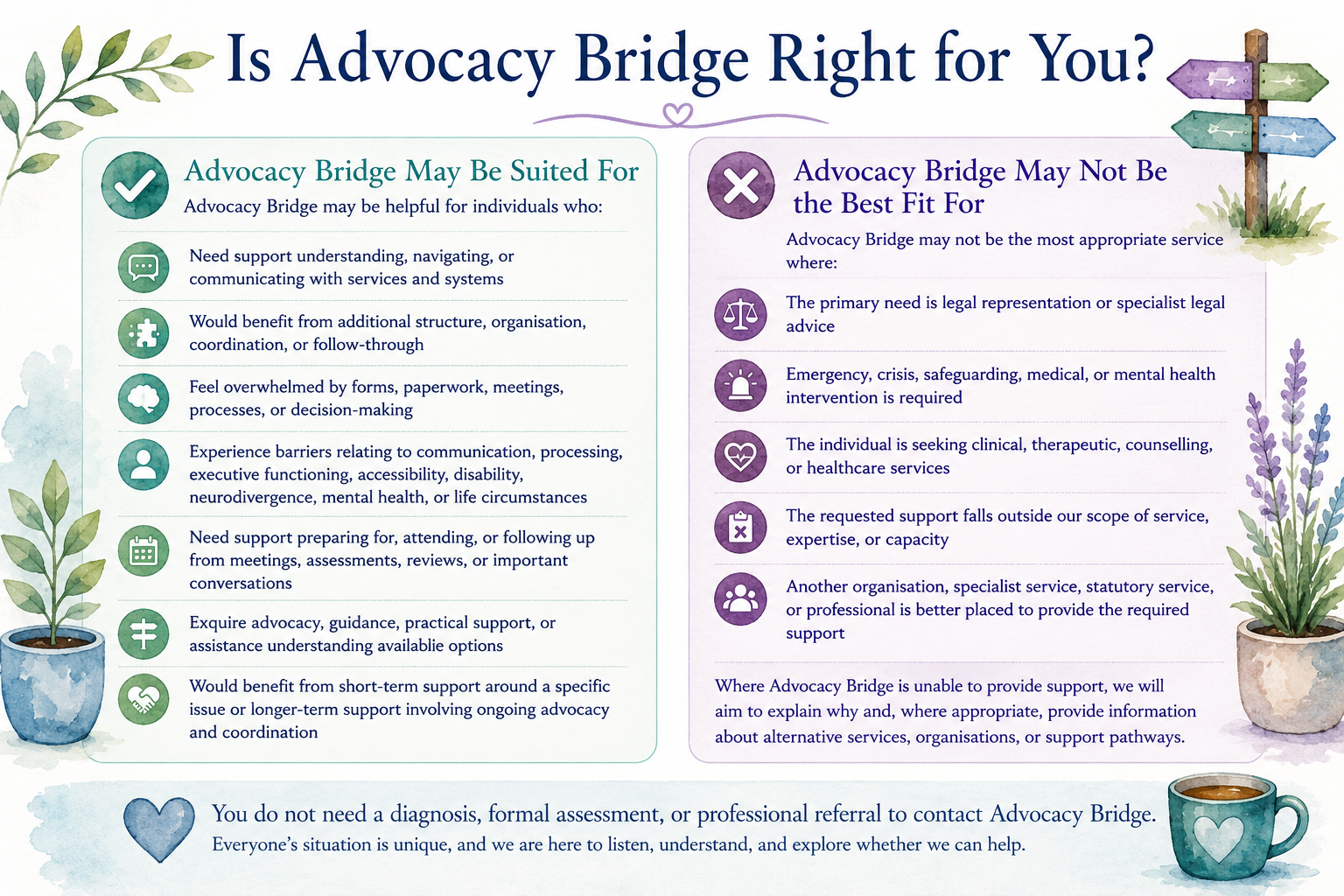
We are not a crisis or clinical service.
Instead, we provide the relational continuity and steady support that traditional systems often don’t have capacity to offer.
Our role is to stabilise engagement — particularly where someone may feel too overwhelmed, unwell, dysregulated, or anxious to take the first steps alone.
We remain alongside individuals until there is greater clarity, regulation, and confidence to engage more independently with the services around them.
By strengthening engagement and continuity, Advocacy Bridge helps existing services work more effectively — improving outcomes without adding pressure to already stretched systems.
How We Support Organisations
Advocacy Bridge works alongside professionals, services, and community providers to strengthen engagement and improve accessibility for the individuals they support.
We help organisations to:
-
Adapt delivery approaches to be more inclusive and capacity-aware
-
Communicate in ways that feel clearer, calmer, and more accessible
-
Reach individuals who may struggle to engage through traditional pathways
-
Reduce disengagement where systems feel overwhelming or hard to navigate
Our role is not to critique existing services, but to complement them — helping bridge relational and communication gaps that can impact outcomes.
A Relational Bridge
At the heart of this work is the belief that everyone deserves someone in their corner — especially when systems feel difficult to access or sustain engagement with.
We stand beside individuals, not above them.
We guide, advocate, and support people to move from feeling stuck or overwhelmed to feeling steadier, clearer, and more supported — strengthening their ability to engage with the services around them.
By improving engagement and reducing barriers, Advocacy Bridge helps organisations deliver support more effectively — without adding pressure to already stretched teams.
.
Bridging The Gap For
Our Community
Who We Support
Advocacy Bridge supports adults who may be finding it difficult to navigate services, systems, or life transitions on their own.
People access support in different ways — some self-refer, while others are introduced through organisations, health services, community groups, or trusted professionals.
While some individuals may not appear to be in immediate crisis from the outside, their inner world can feel deeply unsafe, overwhelmed, or fragile.
Advocacy Bridge recognises that distress isn’t always visible — and that many people struggle quietly while still trying to function, attend appointments, or engage with services.
We are often contacted when someone:
-
Finds it difficult to stay engaged with calls, emails, or appointments
-
Feels overwhelmed by forms, applications, or required processes
-
Shuts down, withdraws, or masks distress during service interactions
-
Struggles to express needs, priorities, or questions in meetings
-
Is neurodivergent and navigating executive functioning, processing, or sensory challenges
-
Moves between services without clear progress, continuity, or resolution
-
Feels distressed or close to disengaging but does not meet crisis thresholds
-
Would benefit from calm, steady support to remain engaged with services
How People May Experience This
Support may feel helpful if someone is:
-
Trying to manage multiple services or demands at once
-
Navigating benefits, housing, employment, or health systems
-
Experiencing burnout, overwhelm, or decision fatigue
-
Awaiting diagnoses, assessments, or funding outcomes
-
Rebuilding confidence after difficult service experiences
-
Wanting someone alongside them to help think, plan, or communicate
What Referrers Can Expect
Advocacy Bridge works in partnership with referrers, professionals, and existing services to support individuals in a way that feels steady, respectful, and person-led.
Collaborative Working
We work alongside referrers and wider support networks, respecting professional roles and avoiding duplication.
Our aim is to complement — not replace — the work already in place.
Person-Centred, Consent-Led Advocacy
Support is always guided by the individual.
Our role is to walk alongside them until they feel able to understand options, communicate needs, and advocate more confidently for themselves.
Steady, Regulating Support
We offer calm, consistent advocacy that helps stabilise engagement — particularly during periods of overwhelm, transition, or service fatigue — reducing the risk of disengagement or drop-off.
Time-Limited, Purpose-Led Involvement
Our involvement remains focused and intentional.
We stay alongside the person only for as long as support is helpful, stepping back when they feel able to continue independently or with existing services.
Barrier-Aware, Non-Judgemental Approach
We recognise the practical, emotional, and communication barriers that can impact engagement.
Our work focuses on reducing these barriers without blame, pressure, or pathologising the individual.
Feedback Into Systems (With Consent)
Where appropriate — and always with consent — we may share insight with services to help improve communication, accessibility, and pathway clarity.
This can support more inclusive, workable systems for the individuals they serve.
Our Role
Our role is to support progress without pressure — creating conditions where people feel safe enough to engage, heard enough to participate, and steady enough to move forward.
How to Access or Refer Into Advocacy Bridge
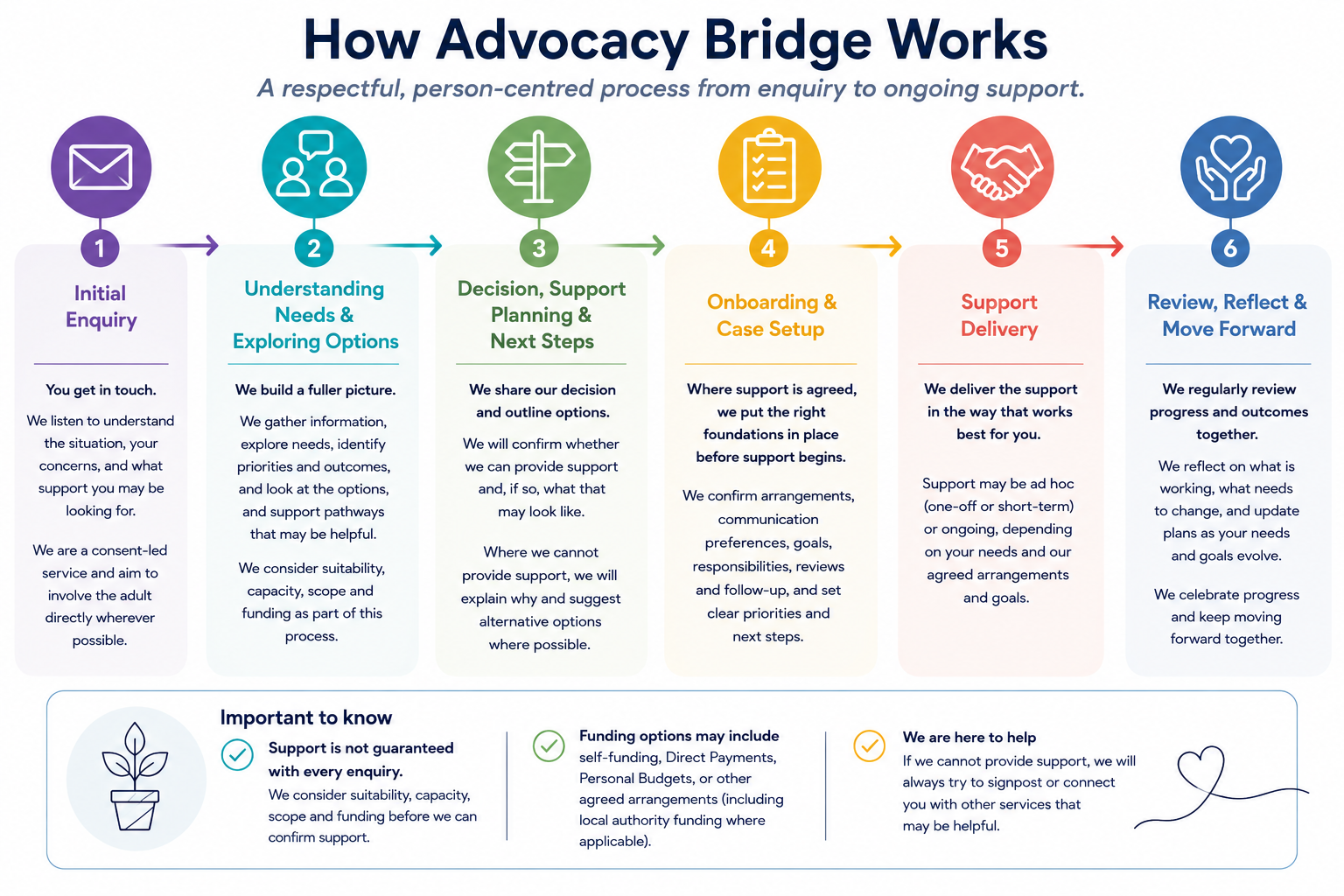
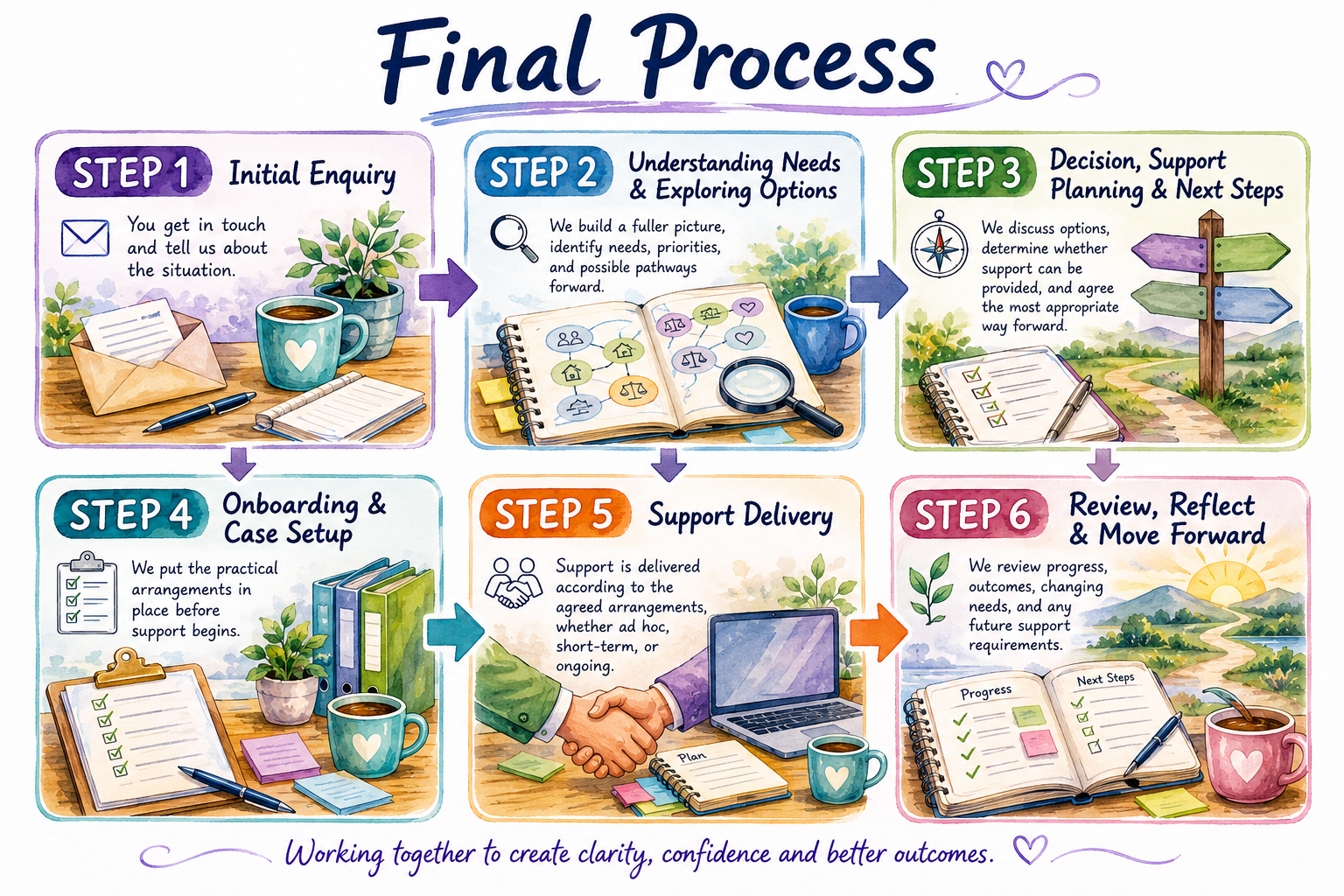
There are a few simple ways to begin support, depending on what feels most appropriate for you or the person you’re supporting.
1️⃣ General Enquiry (Not sure where to start)
If you’re unsure what support is needed — or simply want to make an initial enquiry — you can complete our Contact / Enquiry Form.
This is a light-touch form used to:
-
Ask questions
-
Explore whether advocacy feels appropriate
-
Check availability or next steps
We’ll respond within 24 hours in line with your contact preferences.
If support feels appropriate, we’ll guide you to the correct referral or intake form from there.
2️⃣ Self-Referral (I’d like support myself)
If you’re seeking advocacy support directly, you can complete a Self-Referral Form.
This gathers a full picture of your situation, including:
-
Support needs
-
Communication preferences
-
Capacity and wellbeing considerations
-
Funding or employment context
Only one form is required to begin support.
3️⃣ Referring Someone Else
If you are referring another person (with their consent), please follow these steps:
Step 1 — Check consent
Please confirm the individual is happy to be referred and understands support is direct, one-to-one advocacy.
Step 2 — Submit a Referrer Form
Provide basic details such as:
-
Name
-
Preferred contact details
-
Brief context (only what the person has agreed to share)
Step 3 — Client Intake Form
Before support begins, the individual will be invited to complete a Client Intake Form so we can understand their needs safely and directly.
What Happens Next
Once referred or self-referred:
-
Advocacy Bridge works directly with the individual
-
Support is person-centred and paced appropriately
-
We are not a case-holding or reporting service
We do not share updates or personal information with referrers or other services unless explicitly requested and consented to by the individual.
Consent-Led Information Sharing
All information is handled confidentially.
No details are shared with external services without clear, informed consent from the person receiving support.
Our Approach
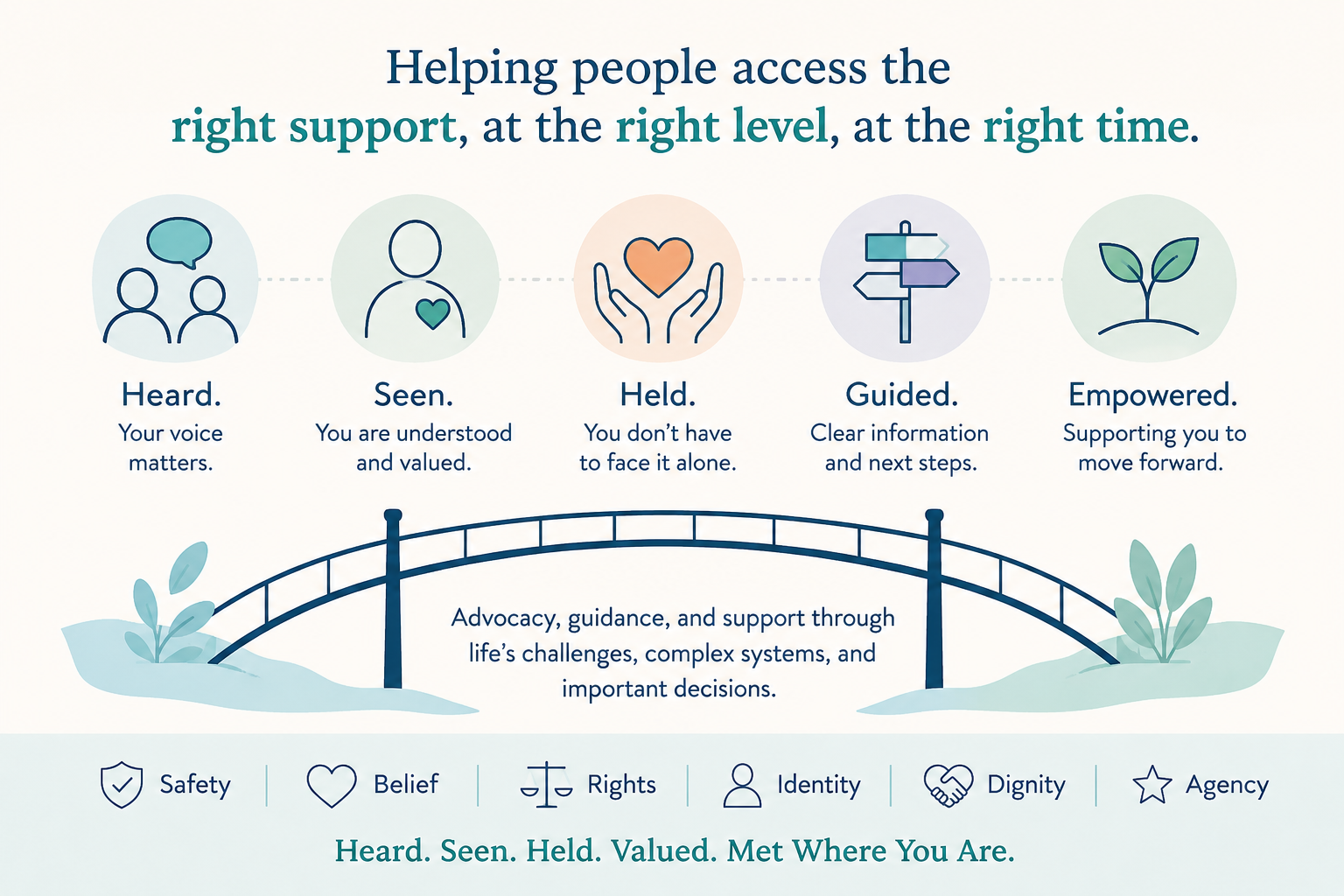
Advocacy Bridge offers steady, person-centred advocacy that helps individuals:
-
Understand their options
-
Navigate systems and services
-
Regain voice and agency
-
Move forward at a safe, supported pace
Not sure where to start? Use the Enquiry Form.
Seeking support yourself? Complete our Client Intake Form.
Referring someone else? Click on Refer Someone (Referrer Form.)
📍 Based in Dinnington Sheffield (S25) — Supporting people UK-wide
🔗 Not sure what you need? Get in touch for a no-pressure chat.
Supporting Adults Across the UK
Advocacy Bridge CIC offers remote, one-to-one advocacy and navigation support to adults across the UK.
We work with people who are emerging from crisis, moving through transition, or stabilising after disruption — particularly where systems feel overwhelming or inaccessible.
Support is delivered at a pace that feels safe, clear, and achievable, wherever you are based.
🧭 Our Story
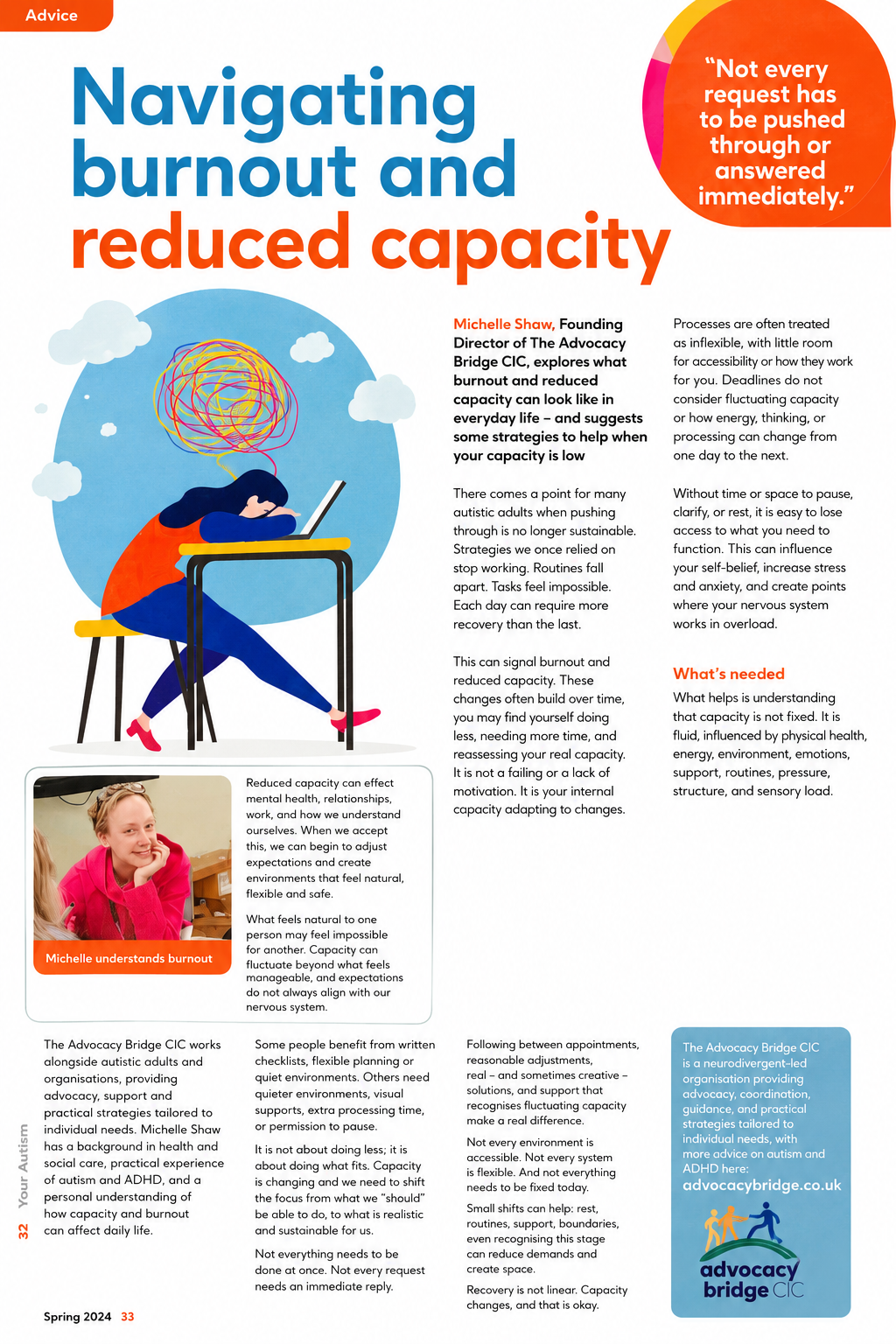
The Advocacy Bridge CIC was created from real life, not theory.
Far too many people find themselves lost in a maze of services, forms, assessments, and long waiting lists. Support that should help often feels confusing, inconsistent, or impossible to access — especially for people who’ve always managed on their own, until something changes and everything suddenly feels too heavy to handle alone.
Our founder, Michelle Shaw, lived this reality herself. As she navigated her own challenges and supported those around her, the same patterns kept emerging:
People unsure where to begin.
Unsure who to trust.
Unsure how to make themselves heard.
Gradually, people started coming to her — often when they didn’t know where else to turn.
The Advocacy Bridge CIC grew from that reality.
It formalises what Michelle was already doing naturally: supporting people to slow things down, make sense of complex situations, communicate clearly, and move forward when everything felt jammed or overwhelming.
“I didn’t need another leaflet or a helpline. I needed someone who didn’t need me to repeat myself for the hundredth time — someone who could anticipate my needs, walk me through what to do next, and explain what to expect, instead of expecting me to speak up on demand.
Michelle didn’t just listen — she helped me make sense of everything and took practical steps with me. I honestly don’t know what I would have done without her.”
“I felt invisible without Advocacy Bridge. Services were bouncing me around, and no one really understood what I was going through. Michelle saw the full picture — and she helped me slow everything down where I could just get back to breathing and feeling human again.”
“I’d been trying to get support for months but didn’t know what I needed or what anything was called. Within one week of connecting with Michelle, things started moving. She knew who to speak to, how to ask, and what to say in a way that got things moving for me.”
“Michelle is the bridge between intention and delivery.
Where services often miss the mark, she steps in and makes sure no one is left behind.”
“She brings clarity, compassion, and accountability — not only for the people she supports, but for the professionals working around them.
She challenges gently but effectively, always keeping the person at the centre.”
“Our staff learned so much simply by watching how she worked.
She holds space with calm confidence and builds trust faster than any engagement strategy we’ve tried.”
Featured Foundation Sponsors
News & Updates
The Instruction Manual You Didn’t Know Existed
Some people move through life with a quiet sense that something is off. They work harder than others just to keep up.They rehearse conversations in their head.They copy behaviours.They feel exhausted after “normal” days.They wonder why simple things feel so...

Most People Look at a Tombstone and See Dates
🌿 Most People Look at a Tombstone and See Dates. I Look at a Tombstone and See a Story. Not when someone lived —but how they lived.Who they became.What they fought for.What they survived.And how their soul evolved across the chapters of their one and only life. Maybe...

✨ The Strengths We Learn to Hide
A reflection on neurodivergence, childhood messages, and the skills we never realised we were building There are some conversations that stay with you long after they end. Not because they were dramatic or difficult, but because they reveal something quietly profound...
Get in Touch. Get Involved.
The Advocacy Bridge CIC is built on connection and collaboration. If you’d like to refer someone, partner with us, volunteer, or support our mission, we’d love to hear from you.
Matrix@Dinnington Business Centre, Nobel Way, Dinnington, Sheffield S25 3QB
📞 01709 262005