

Some people move through life with a quiet sense that something is off.
They work harder than others just to keep up.
They rehearse conversations in their head.
They copy behaviours.
They feel exhausted after “normal” days.
They wonder why simple things feel so complicated.
But they don’t have the words for it.
No map. No explanation. No context.
You’re conscious. You’re trying. You’re aware something doesn’t quite fit.
But no one ever handed you the guidebook to how your system works — or told you that understanding and adapting was possible, rather than believing you needed to be fixed or replaced.
⸻
Then there’s something different again
Some people don’t feel anything is off — and may assume the difficulty always lies outside themselves. With situations. With other people. With the world.
They don’t see the value in looking inward.
They don’t feel the need to question their patterns.
They don’t always notice how they impact others.
They may not recognise when someone else is struggling differently — and may not feel ready to.
This isn’t about blame or fault.
It’s simply a lack of self-reflection — often learned, protected, or never modelled.
At its core, unconsciousness is about whether self-reflection was ever made safe, valued, or necessary.
Not yet realising there’s more to understand — about yourself and about others.
⸻
Why this distinction matters
From the outside, both can look similar:
Rigid responses. Misunderstandings. Difficulty adapting. Emotional disconnection.
But internally, they’re worlds apart.
One is searching for answers.
The other doesn’t yet see why there would be questions at all.
Someone who is even slightly self-reflective can:
Notice their own reactions.
Consider another perspective.
Acknowledge struggle.
Be curious rather than defensive.
Someone who isn’t there yet often operates on autopilot:
Stays in action mode.
Minimises inner experience.
Avoids emotional complexity.
Treats problems as external only.
Neither is right or wrong.
They simply create very different relational realities.
One makes space for understanding.
The other keeps experience on the surface.
⸻
The late-discovery moment
Many adults who later discover they’re neurodivergent describe a familiar turning point.
Some are told they’re broken.
Others feel broken.
But often, the reality is that the way they were living was unsustainable — and their system finally told the truth.
For some, recognition brings clarity.
For others, it brings questions — and a long-overdue process begins.
Exhaustion had a name.
Social struggles gained context.
Shutdowns and overwhelm were no longer evidence of personal failure.
The instruction manual finally appears — often in midlife, after everything that once worked no longer does.
With it comes relief… grief… collapse… deconstruction… and rebuilding.
Relief at finally having a name for what is now understood to be a disability — one that is recognised and supported across wider systems.
Grief for years spent dysregulated without medication, trying to steady myself through conflict and contortion without support or understanding.
Collapse as old identities and coping strategies fall away.
Deconstruction of beliefs about who you were “supposed” to be.
Rebuilding a life unconsciously created — slowly, carefully — into someone more aligned, more real, more free.
⸻
Reorganisation
This phase is rarely neat or linear.
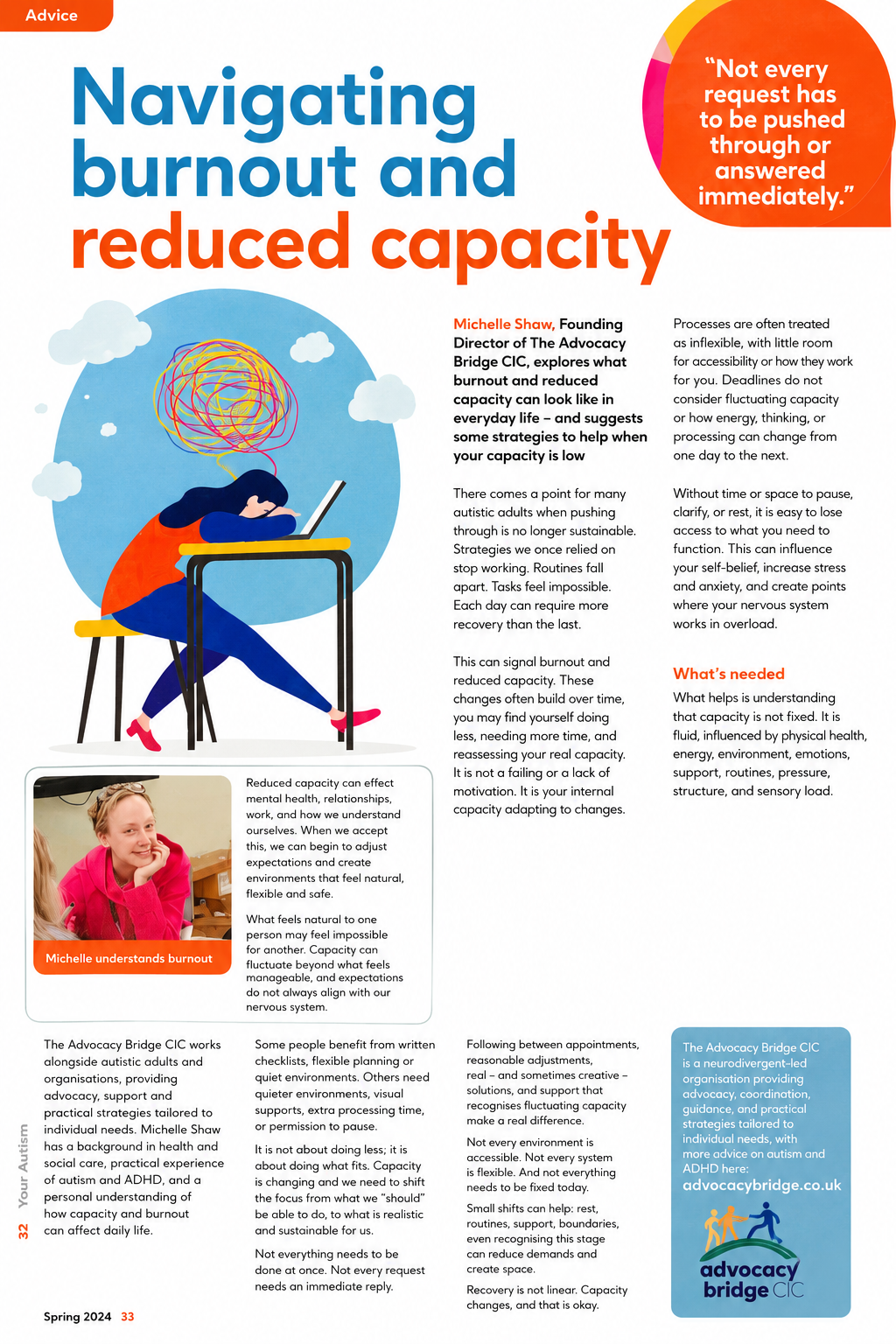
It can look like burnout, withdrawal, loss of confidence, or stepping away from work, responsibilities, routines, and roles.
From the outside, it may not be recognised for what it is — and can appear more chaotic than it feels from within.
Inside, it is reconstruction, recalibration, and integration.
A system finally updating, a personality evolving, a self finally allowed to grow up — stepping back into the world, carefully picking up where life left off after everything crashed, discovering what fits and works now.
This is where many people need steady, informed support — not to fix, push, or rush — but to make sense of what is unfolding, clarify capacity, and find what fits.
Because in that tentative re-entry, something important happens.
Needs become clearer.
Boundaries begin to take shape.
Support becomes an essential part of everyday life.
This is where real adulthood begins — not by age, but by self-knowledge.
⸻
Why awareness of both matters
If you’ve lived without your own manual — and grown tired of feeling like you’re always getting things wrong — you’ll know how lonely that can feel.
If you’ve lived around people who don’t recognise inner worlds, you’ll know how invisible that can feel.
Real connection only happens when we:
Become curious about ourselves.
Stay gentle with differences in others.
Stop assuming everyone runs the same operating system — or had the same start in life.
Not everyone can or wants to open the manual.
Not everyone is ready to know there is one.
But awareness spreads quietly.
Through conversations.
Through reflection.
Through safe spaces to explore.
And sometimes, all it takes is one moment of recognition to change a life.
⸻
A gentle invitation
If any of this reflects your experience, there are others who understand.
Whether you’re sensing something unexplained in yourself, supporting someone who struggles differently, or simply wanting to understand people more deeply — the first step is the same:
Noticing there might be an instruction manual at all.
Everything begins there.
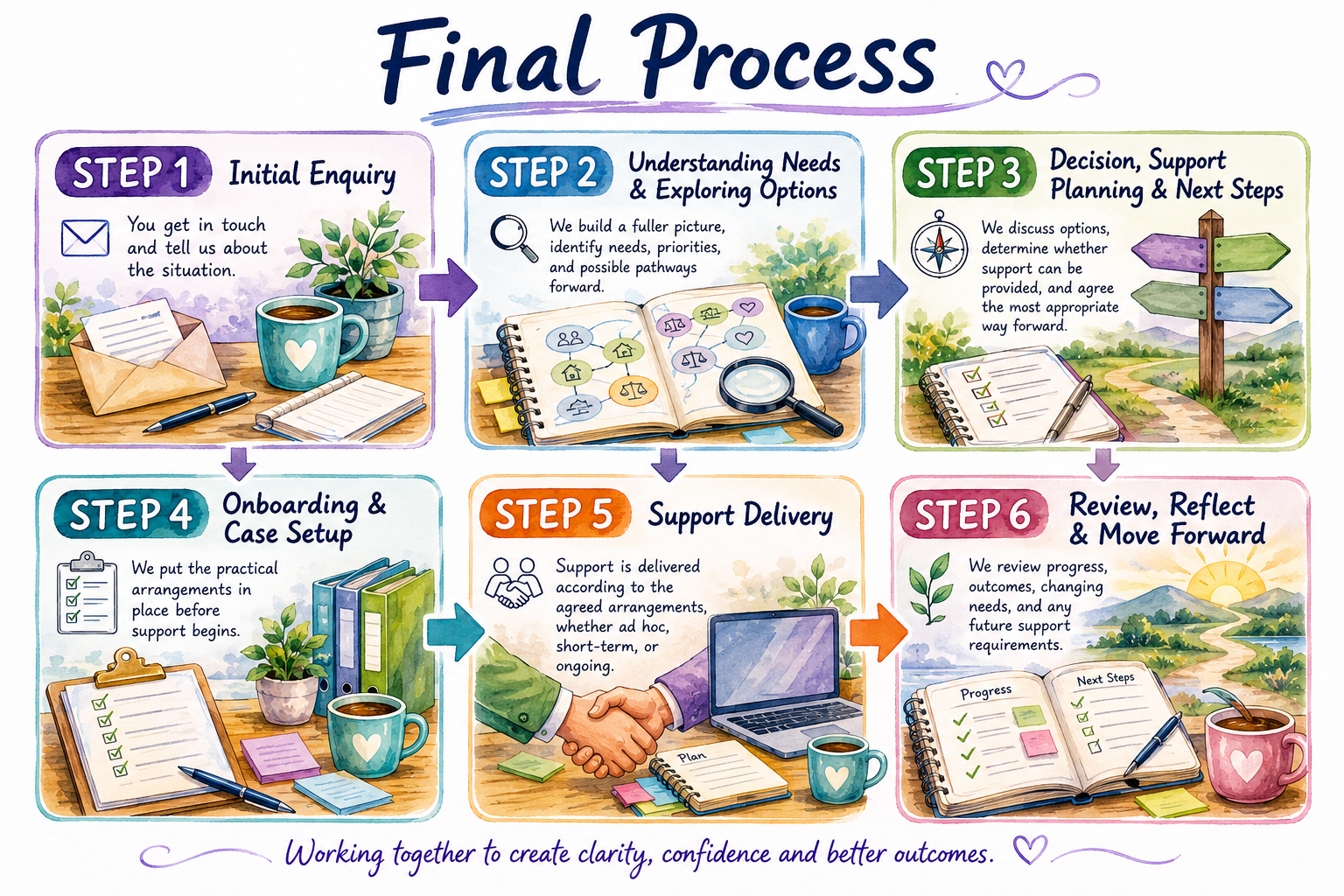
I work with adults — and professionals supporting them — offering reflective, structured conversations that help people understand their inner experience, capacity, and next steps.
Professionals, referrers, and individuals are welcome to connect.
⸻
If this piece helped you see something more clearly today, you’re welcome to share it with someone who might benefit.
#LateDiagnosis #NeurodivergentAdults #IdentityRebuild #TraumaInformed #Advocacy #InvisibleDisability #Unmasking #ReflectivePractice